The book
The Team That Stays, 2026 edition, PDF, 88 pages: an introduction, 15 chapters in four parts, an epilogue, appendices C and D, the author’s page and the sources.
The trigger on the day of departure is not the cause. The decision is older than the day it is spoken.

Open any text about turnover in hospitality and you get a list of ten to twenty measures, all written in the same tone and all equally sure of themselves. Nothing in that list separates a measure that was measured from one somebody wrote down because it sounds reasonable. Chapter 11 splits them into three groups and says which group each one is in.
| The group | What it means in the book |
|---|---|
| Group 1 — measured, and the effect is there | Four measures. The quality of the manager, not undermining a new person in the first weeks, pay, and not cancelling shifts or posting the schedule a day ahead. Each one with where it was measured, on whom, and what the figure does not say. |
| Group 2 — measured and it did not work, or there is no measurement | Clopening: the only measurement that examines it finds no significant link with turnover. A predictable schedule: the one randomized experiment raised sales and left turnover where it was. Tip pooling and a retention bonus: not one study measuring the effect on turnover. |
| Group 3 — reasonable, without evidence | Given as the author’s own opinion out of the trade, and labelled as that — not as evidence. The stay interview sits here, and the book says so even while recommending it. |
| Every figure | Carries who it was measured on, where and when: hotels or restaurants, an experiment or an observation, which year’s money. Anything unconfirmed is marked as unconfirmed. |
| The sources | Every source opened, with the date of access, listed at the back of the book. Where there is no evidence, the text says there is none instead of filling the gap. |
The restaurant in the examples is Acacia — a fictional restaurant, the same one as in the other books in this collection. The people and events are made up so the arithmetic and the method can be shown in full; they promise no result.
Every chapter opens with a scene from Acacia or a voice from the trade, then what actually happens, then what of it can be seen in the data the operation already has — and ends with one thing to do in your next shift. A figure appears only where the column on the right shows one.
| No. | Chapter | Chapter figure | What is inside |
|---|---|---|---|
| Part One · What actually happens | |||
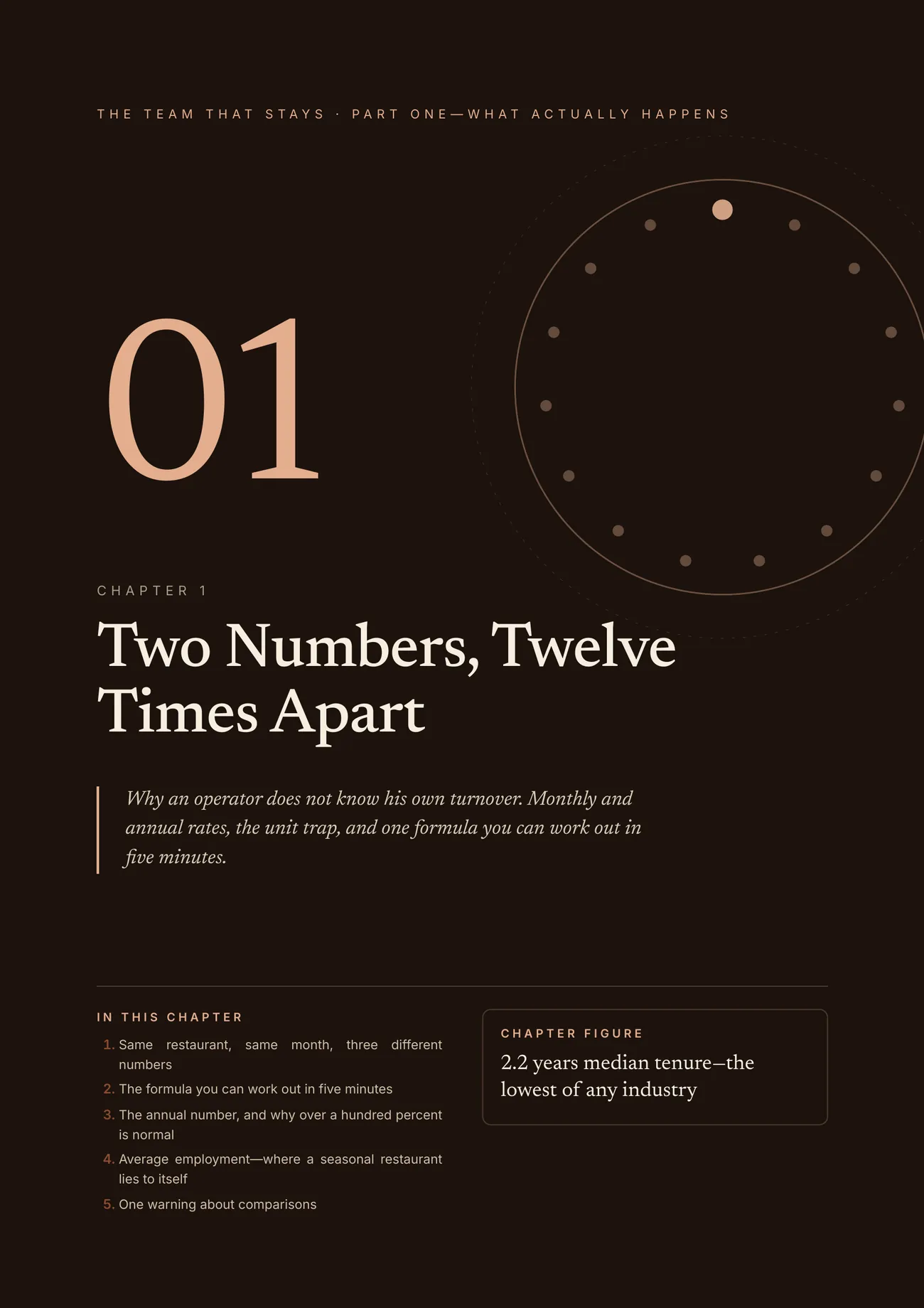
| 01 | Two Numbers, Twelve Times Apart | 2.2 years | Why an operator does not know his own turnover · monthly and annual rates · the unit trap · one formula you can work out in five minutes · why over a hundred percent is normal |
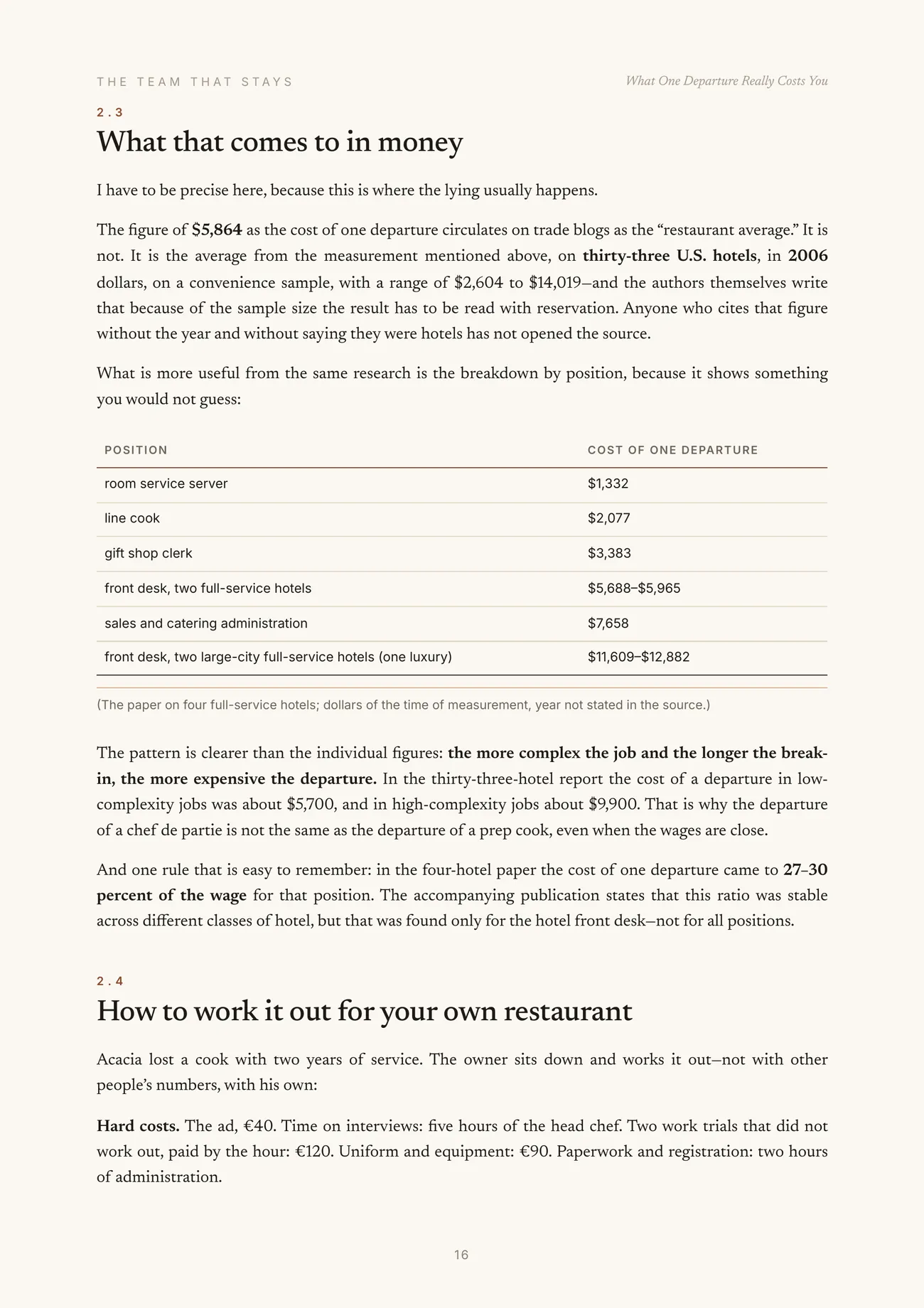
| 02 | What One Departure Really Costs You | 52% | First what you can see, then what you cannot · 54 to 80 working days at half strength · the cost by position · 27–30 percent of the wage · how to work it out for your own house |
| 03 | Five Faces of the Same Problem | — | Front of house · the bar · the kitchen · the dish pit · rooms · around the house and the short stays · why the highest turnover and the least attention sit on the same positions |
| Part Two · The four decision points | |||
| 04 | The Schedule: “What the Restaurant Needs, Not What Fits Into Your Life” | — | It is not the number of hours but the impossibility of planning · a canceled shift and notice shorter than three days have been measured · clopening, which the whole trade curses, did not show up as significant |
| 05 | Respect: People Leave Over What Happened to a Colleague | — | The breaking point is often someone else’s · working sick · raised voices · harassment · what you do about it |
| 06 | Money: What Has Been Measured, and What Gets Claimed | — | Pay works, but less than people think · with tips it is the amount and not the percentage · on tip pooling there is not one single study, and the book says so · what people themselves say about money |
| 07 | Advancement: “Topped Out” | — | What the ceiling looks like by position · a promise is worse than nothing · what has been measured about training and mentoring · three steps that cost nothing |
| Part Three · Where the decision is born | |||
| 08 | Exhaustion: The Thing Nobody Complains About | — | The one decision point that has no words · the strongest figure in the whole subject, and the qualification that has to stay attached to it · what can be done in this trade and what cannot |
| 09 | The First Thirty Days | ×3 | Support declines week by week, and that can be seen · undermining by the supervisor predicts departure, by colleagues it does not · why thirty days and not ninety · one thing you can measure tomorrow |
| 10 | The Manager Is the Strongest Lever That Has Been Measured | −60% | “People leave managers, not companies” has no source — and the thing it claims has been measured · what “a good manager” means in actions, not in traits · why this is the owner’s problem |
| Part Four · What you do | |||
| 11 | An Honest List: Proven, Unproven, Reasonable | 4 of 13 | Group 1, measured and the effect is there · group 2, measured and it did not work or there is no measurement · group 3, reasonable and given as an opinion · how to read the chapter when somebody is selling you something |
| 12 | Measuring Without Lying to Yourself | 72% | Three numbers a month are enough · quits and layoffs kept apart · regretted and non-regretted departures · four ways to lie to yourself · why a house compares itself with itself |
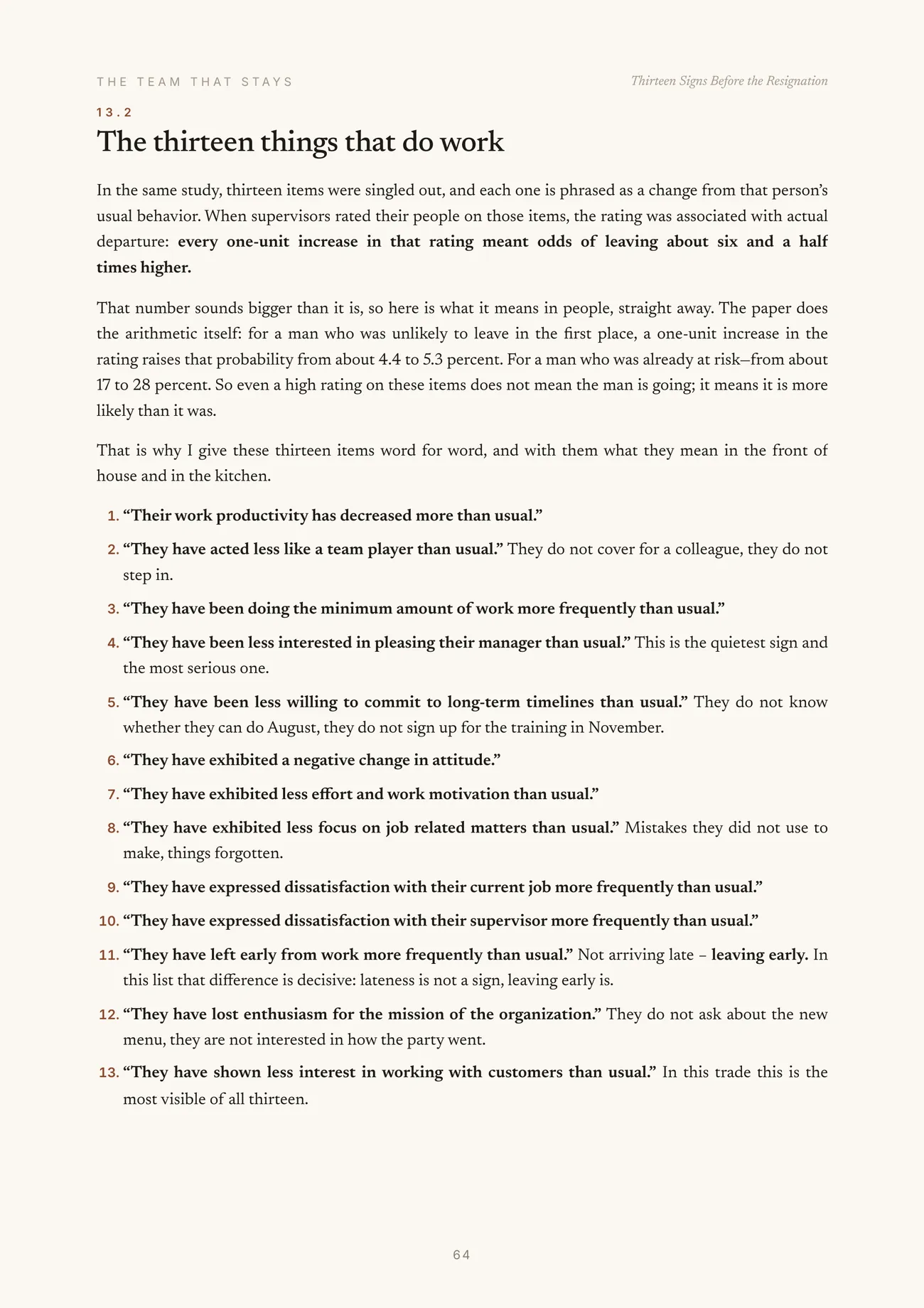
| 13 | Thirteen Signs Before the Resignation | ×6.5 | Lateness, sick days and vacation are not signs — that has been measured · a change from what is usual for that person is · the thirteen items word for word · the limits, so this is not made bigger than it is |
| 14 | The Exit Interview and the Stay Interview | — | Why nobody tells the truth on the way out and what can still be done with it · the five questions for the people who stay, transcribed from the source · the call a year later |
| 15 | Rules That Work in Your Favor | EU · US | EU: written terms within seven days, a probationary period of no more than six months, no ban on a second job, the right to refuse a shift outside reference hours, compensation for a late-cancelled shift · US: no federal rule — one state and nine cities, each with its own threshold |
Click a page to see it full size.
The two appendices that do arithmetic come as spreadsheets rather than printed pages, because they are made to be used and not read. The two that are filled in with a pen are typeset in the book.
The Team That Stays, 2026 edition, PDF, 88 pages: an introduction, 15 chapters in four parts, an epilogue, appendices C and D, the author’s page and the sources.
An Excel workbook with four sheets — Input, Output, Annual cost of turnover and Notes. The hard-cost block follows the international HR standard; every estimate block says on the sheet that it is an estimate.
An Excel workbook with five sheets — month by month, the annual calculation, a comparison, charts and notes. Every heading that holds a rate carries its unit, so the monthly and the annual number cannot be confused.
The exit interview and the stay interview, each on one sheet: who runs it, when, what is said at the start, the questions in the same order every time, and the one thing you will do because of it.
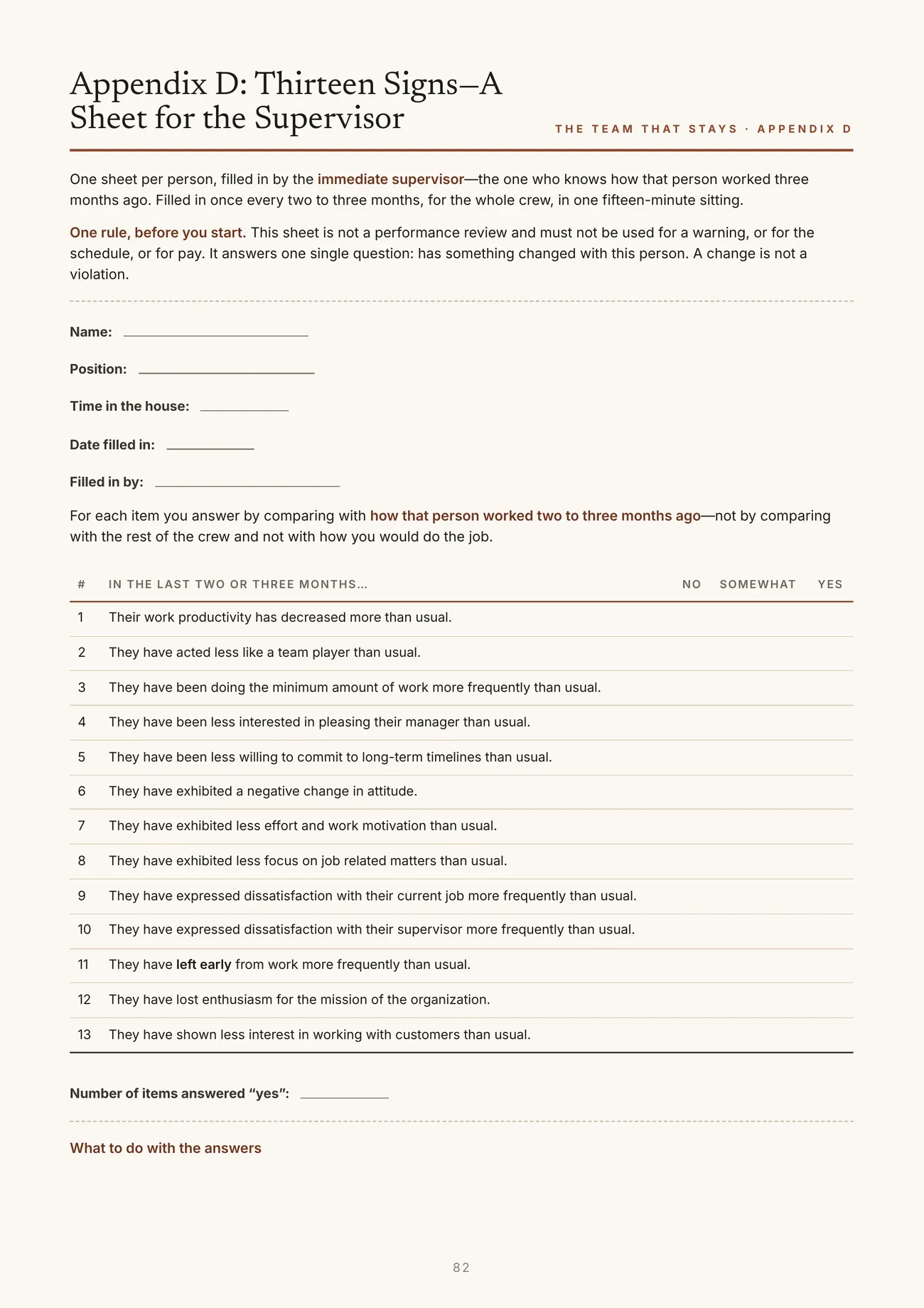
One sheet per person for the immediate supervisor. The thirteen items in plain words, three columns to tick, and what to do with the answers — with the rule that a change is not a violation.
Every open source used, with the date it was opened. Anything the sources do not settle is marked as unconfirmed in the text, in the place where it would otherwise be claimed.
The two workbooks are built with formulas rather than typed-in results, and they run in Microsoft Excel, in the free Google Sheets and in LibreOffice. Neither of them needs a figure you do not already have: they are filled in from the payroll and the schedule.
The licence covers your business and your team: print it, fill it in and use it on every one of your premises.
88 pages, PDF, with both Excel tools.
Checkout is through Gumroad: once you pay, the download link arrives in your inbox right away. Gumroad opens soon — until then, this page is a preview of the book.

More than thirty years in hospitality: in top hotel kitchens and restaurants and on cruise ships. He has worked and lived on four continents and knows both sides of the business — the one at the stove and the one at the owner’s desk.
He is the founder of Gostíno.ai. The Team That Stays is the eighth book in the collection and the second in the People series.
The same job is bound by the same problems everywhere.
An 88-page PDF, 2026 edition. It reads on a phone, tablet or computer. Appendices A and B come with it as Excel workbooks, because they are made to be filled in and not read.
English. The same book also exists in Serbian — the link is at the top of this page.
Both, and the book keeps them apart. Where a claim rests on a measurement, the text says who was measured, where, in what year and by what method. Where it rests on the author’s own experience, it says that too. Where there is no evidence at all — tip pooling, a retention bonus — the book says there is none instead of filling the gap.
Nobody has measured that, and the book does not claim it. Most of the measurements in it were made in hotels, in retail or outside hospitality altogether, and each figure says where. What the book gives you is the evidence as it stands, and a way to measure your own house against itself rather than against someone else’s number.
European Union and United States rules. For the EU it reads the directive on transparent and predictable working conditions, and it says plainly that a directive does not bind you directly — the national law does. For the US it says there is no federal predictable-scheduling rule and names the one state and the nine cities that have one.
No. Both workbooks are built with formulas and run in Microsoft Excel, in the free Google Sheets and in LibreOffice.
No. Acacia is a fictional restaurant, the same one as in the other books in this collection. The people and events are made up so the arithmetic and the method can be shown in full.
Checkout is through Gumroad: once you pay, the download link arrives in your inbox right away. Gumroad opens soon — until then, this page is a preview of the book.




Fifteen chapters that follow it back to where it was made, and four appendices that let you see it coming.