Book 1AVAILABLE
The Choice Algorithm
Menu psychology and architecture: how guests choose, how a menu is put together and how a change to it is measured.
QR menu, allergen matrix, POS and KDS as one system — a source for every rule, an owner for every datum and a human for every critical decision.
The first book explains how guests choose, the second what every dish really costs and earns, the third how software runs all of it for you. Each one also stands on its own.
Menu psychology and architecture: how guests choose, how a menu is put together and how a change to it is measured.
Menu maths: the recipe card to the cent, yield, sub-recipes, portions, purchasing, pricing with VAT, drinks, stock and the monthly reconciliation.
The menu in the digital world: QR menu, allergen matrix, till and kitchen screen as one system — with one source of truth, one order id and a human for every critical decision.
Software vendors promise that “AI will sort it out”. This book labels every claim: EU or US regulation, a standard, hospitality practice, the author’s proposal or an example from a made-up restaurant. Law is never mixed up with advice, and advice is never passed off as law.
From what an ecosystem is and which rules touch it, through the allergen matrix, the QR menu, POS and KDS, to AI as an assistant and the rhythm of daily, weekly and monthly checks. Every part has its own forms, a worked example from one restaurant and sources at the end of each chapter.
| Part | Title | Chapters | Forms in the book |
|---|---|---|---|
| I | The System | 1–4 · ecosystem, rules, roles, human-in-the-loop | A-01 System map · A-02 AI use-case register |
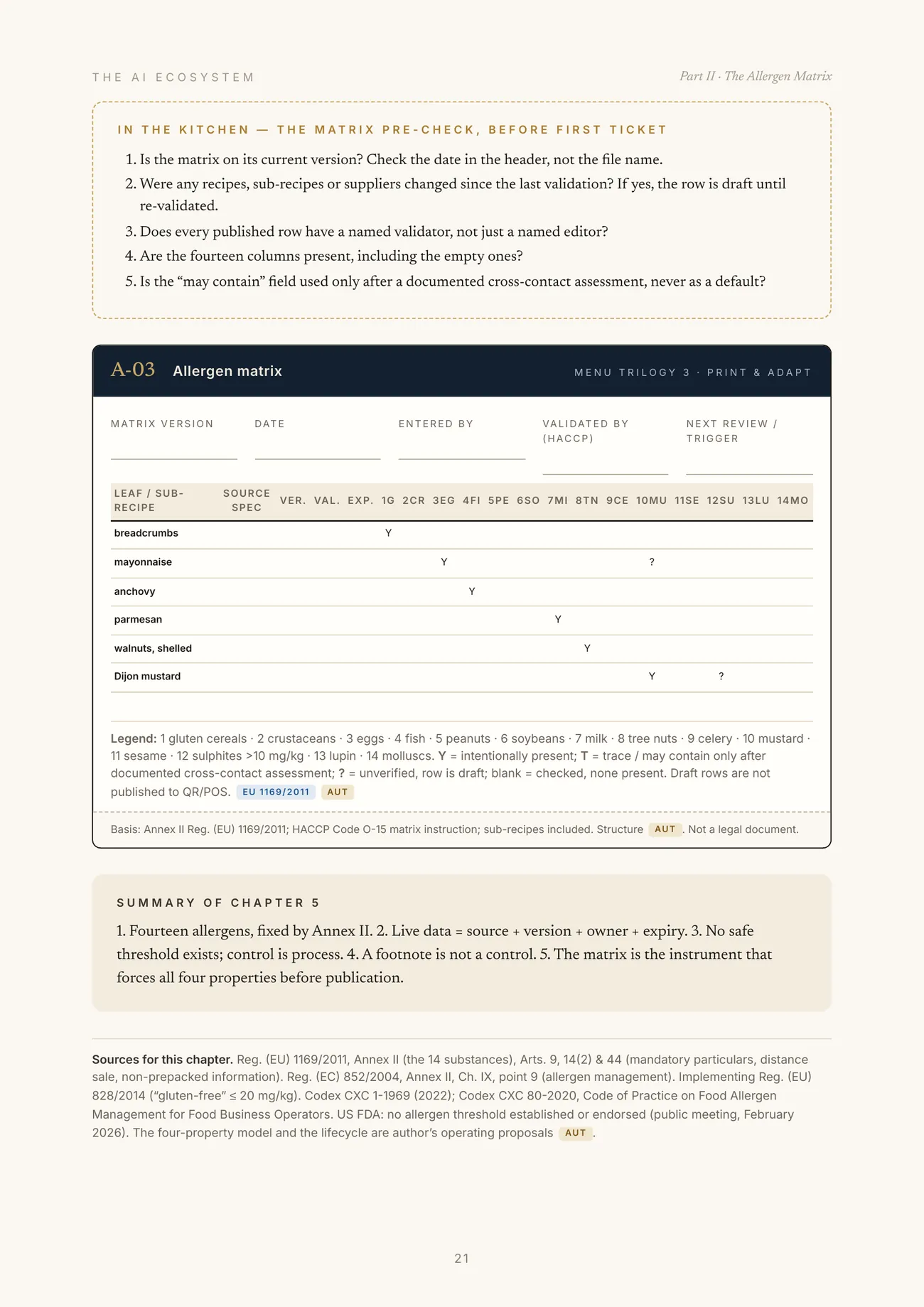
| II | The Allergen Matrix | 5–8 · live data, recipe and variant, cross-contact, the KDS flag | A-03 Allergen matrix · A-04 Recipe register · A-05 Cross-contact controls · A-06 Allergen trace |
| III | QR Menu as Digital Host | 9–12 · QR is not a PDF, accessibility, phishing QR, guest data | A-07 QR launch checklist · A-08 Accessibility & language · A-09 QR physical & data minimisation |
| IV | POS, KDS and the Order Bus | 13–16 · one order id, POS, KDS, delivery platforms | A-10 Integration validation · A-11 POS & KDS pre-shift check · A-12 Digital incident |
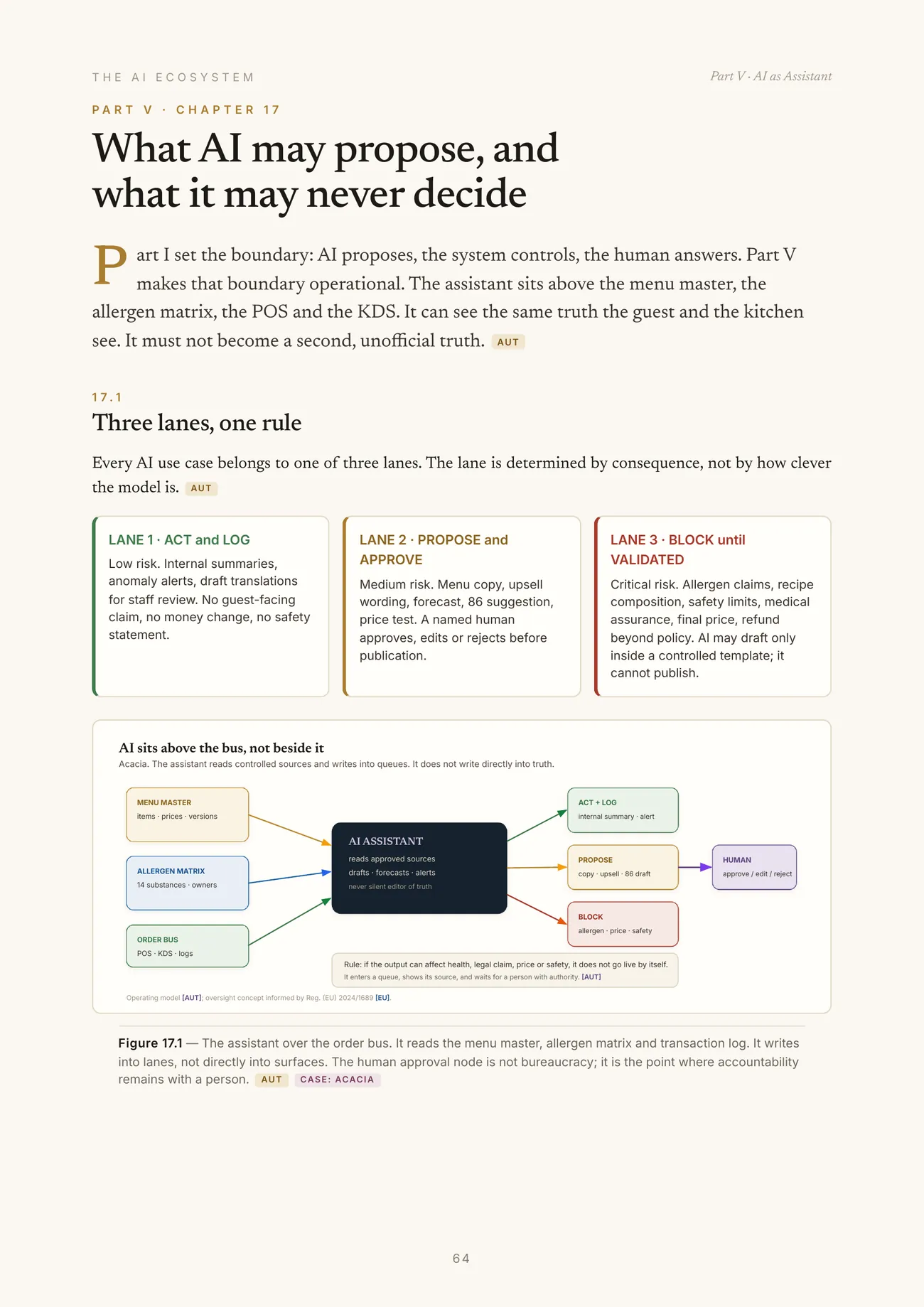
| V | AI as Assistant | 17–21 · what AI may do, descriptions and forecasts, Books 1 and 2 inside the system, hallucinations, vendors | A-13 AI output review · A-14 Vendor due diligence & exit · A-15 AI incident |
| VI | The Operator Cadence | 22–25 · 15 min daily, 45 weekly, 90 monthly, Acacia before and after | A-16 Daily board · A-17 Weekly review · A-18 Monthly governance |
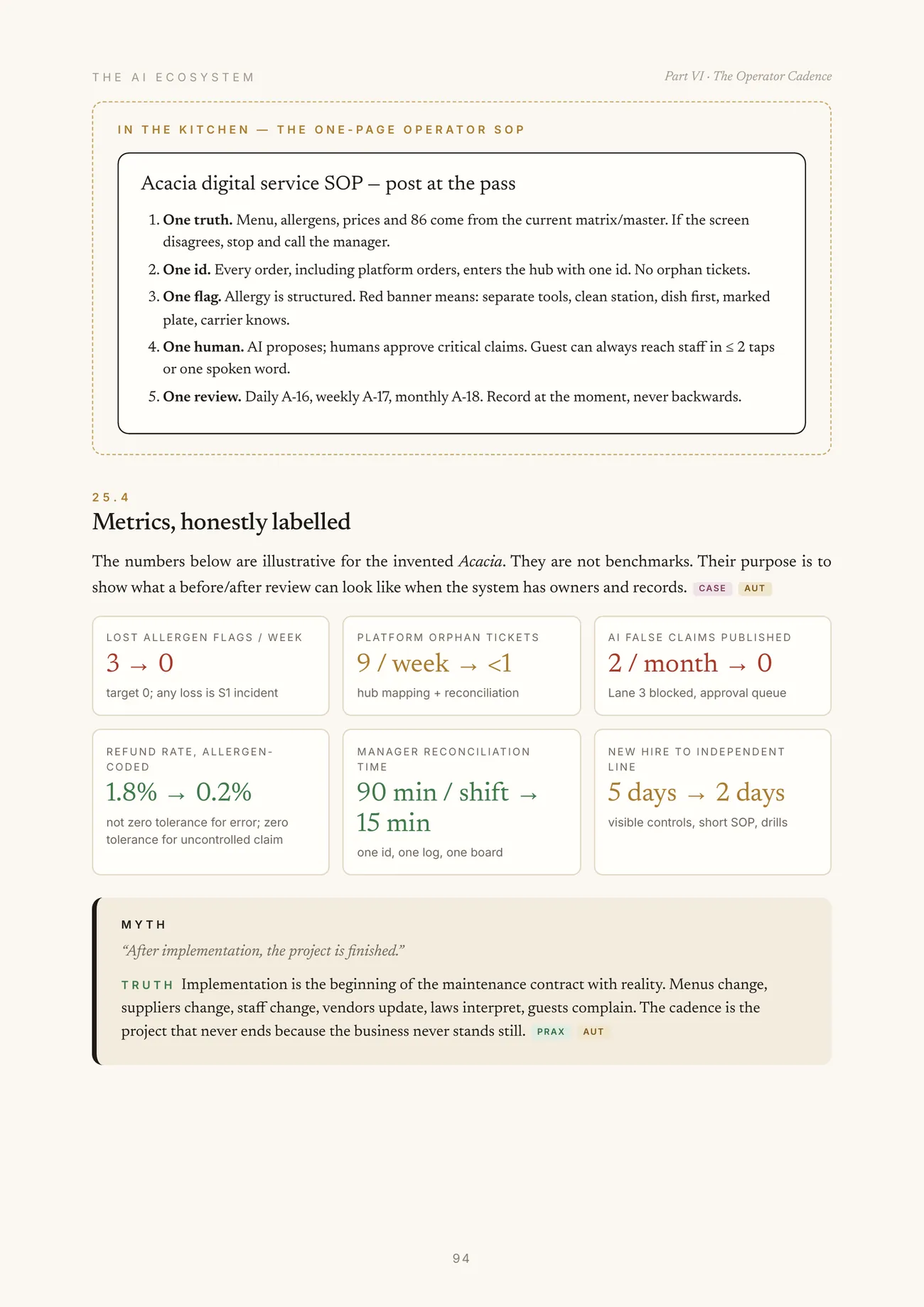
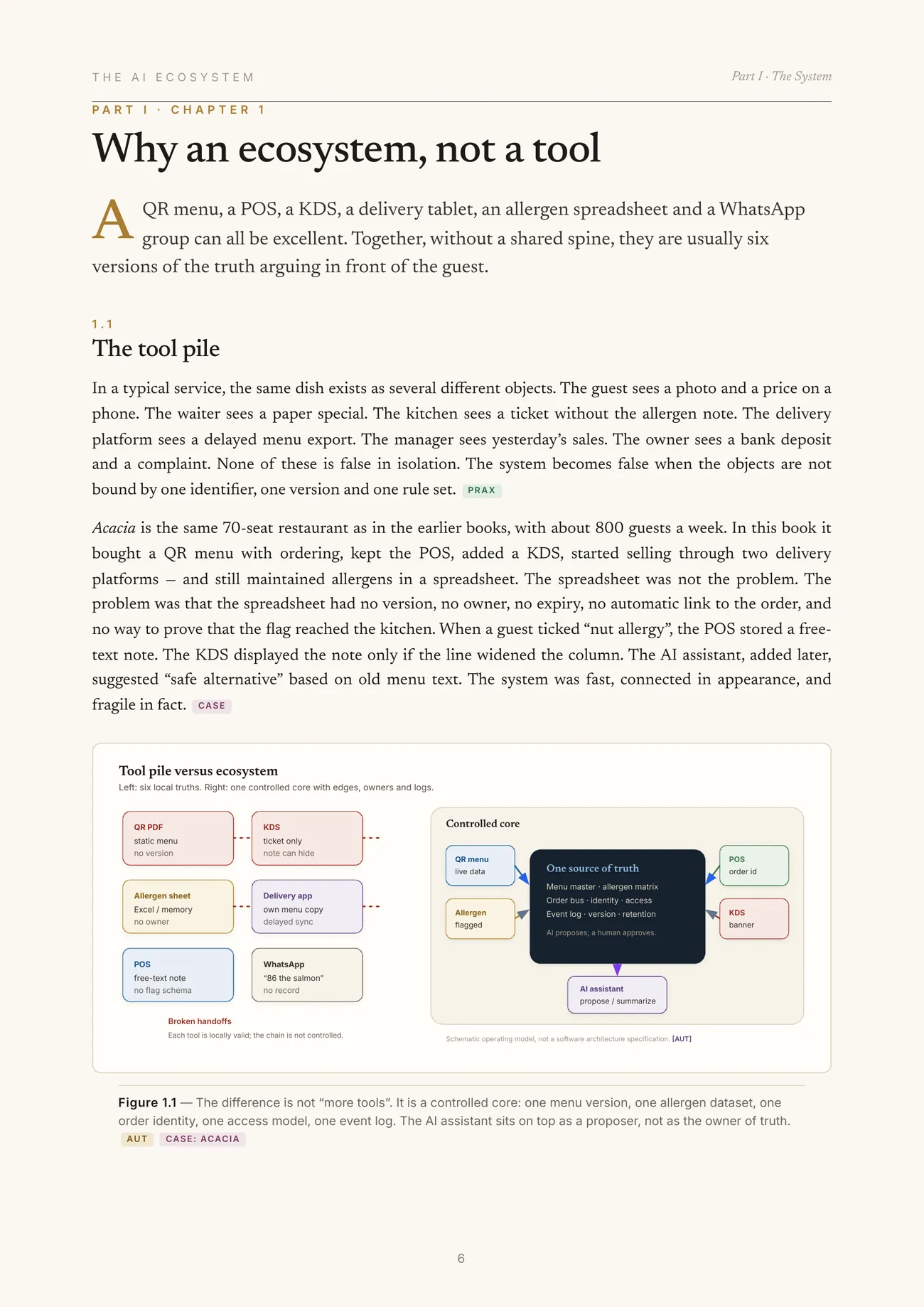
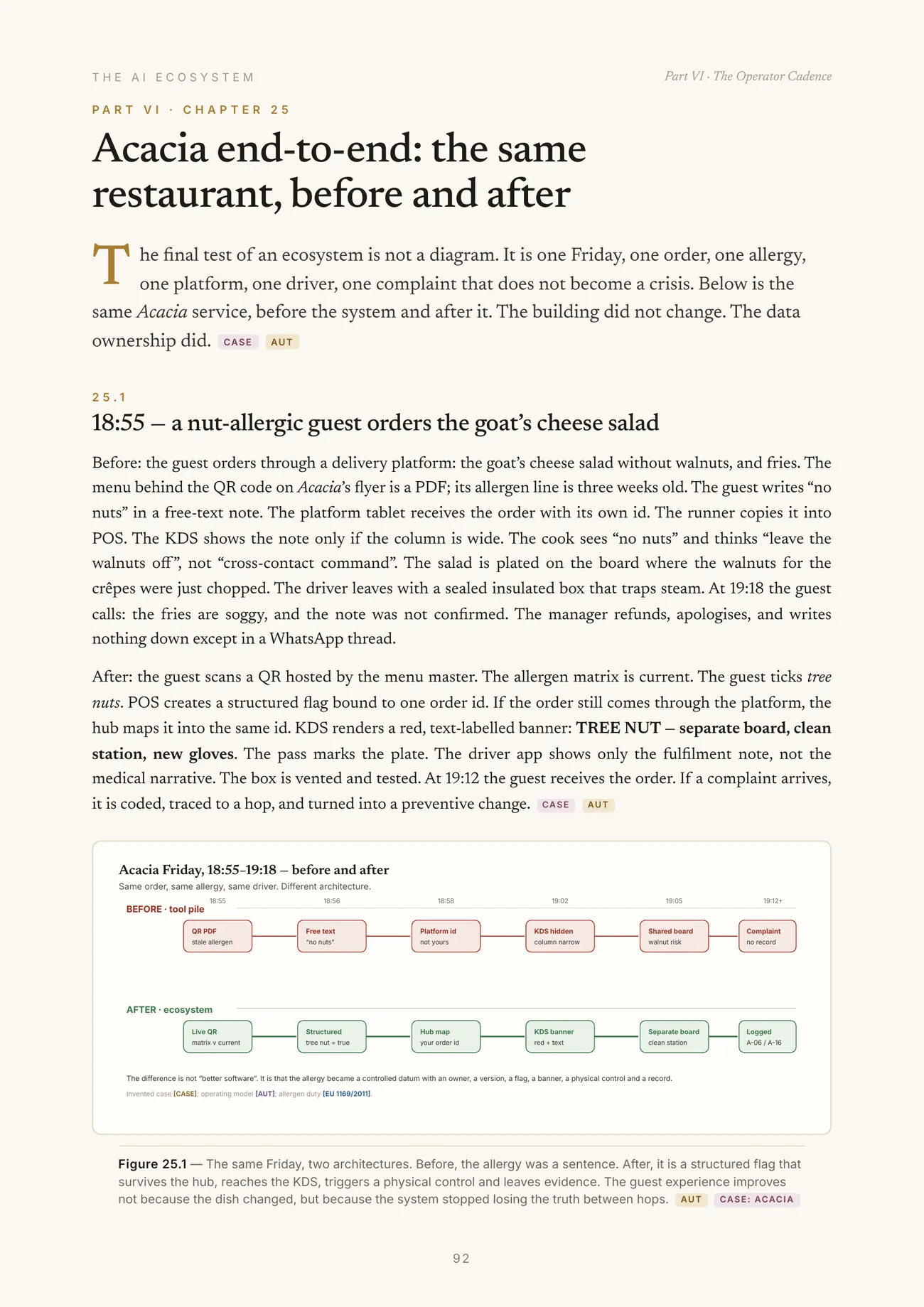
Acacia is the same made-up restaurant as in the first two books: 70 seats, the same menu. Friday, 18:55: a nut-allergic guest orders the goat’s cheese salad through a delivery platform. Before the system, the allergy is a sentence in a note; after it, a structured flag that reaches the kitchen screen, calls for a separate board and leaves a record. The building did not change. The data ownership did.
Each book of the trilogy is one product: the book with every form, workbook, template, poster and video guide that goes with it. Nothing to add on.
The book and every resource with it, for your business and your team.
The workbooks run in Excel (2019 or newer), Google Sheets and LibreOffice; the templates in Word, Google Docs and LibreOffice.
Each book costs €39. All three together cost €99 instead of €117 — you save €18. All three books are out; if you have already bought one or two, you only pay the difference for the set.
Purchases go through Gumroad. After payment, the download link arrives in your inbox straight away.

More than thirty years in hospitality: in top hotel kitchens and restaurants, and on cruise ships. He has worked and lived on four continents and knows both sides of the business — the one at the stove and the one at the owner’s desk.
He is the founder and owner of Gostíno.ai, an agency that helps hospitality businesses run their work with digital tools.
The same job is bound by the same problems everywhere.
A 122-page PDF, 2026 edition. It reads on a phone, a tablet and a computer. The printable forms are A4; the forms you fill in on screen come in A4 and US Letter.
British English. There is also a Serbian edition, AI ekosistem, with the same content.
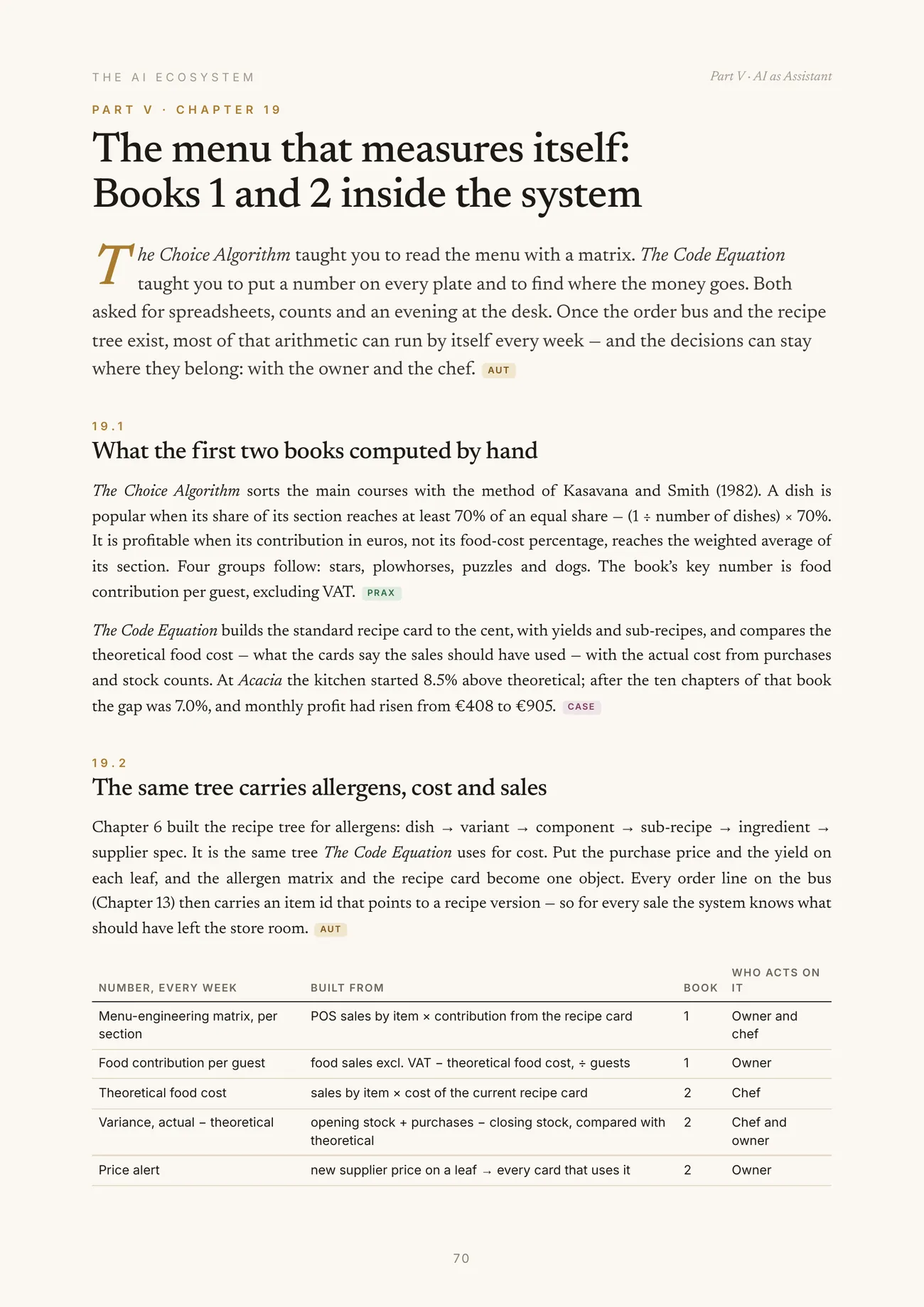
No. The AI Ecosystem stands on its own. If you have the first two, you will recognise Acacia, and Chapter 19 shows how the menu matrix from Book 1 and the recipe card from Book 2 work inside the system, from the same recipe tree.
No. The book sells and praises no program. It gives the rules, tests and forms to check any QR menu, POS, KDS or AI tool — and the vendor contract, including an exit test with your data.
The book relies on EU rules (allergens, hygiene, official controls, data protection, the AI Act, accessibility) and the US FDA Food Code, with standards such as WCAG and Codex — each with its source. It is not legal advice: before you decide, check how your country has implemented the rule.
Every claim says where it comes from: EU or US regulation, a standard, hospitality practice, the author’s operating proposal or an example from a made-up restaurant. That way law is never mixed up with advice.
Everything: printable and fillable forms, six Excel workbooks and the Acacia workbook, Word templates, AI prompts, the monthly review kit, wall posters and video guides. Nothing to add on.
Each book costs €39; all three together cost €99. All three books are out. If you have already bought one or two, you only pay the difference up to €99.
No. Acacia is a restaurant we made up, the same as in the first two books. Its numbers show the method; they don’t promise a result. Every fact from regulation and standards has its source at the end of the chapter.
Purchases go through Gumroad. After payment, the download link arrives in your inbox straight away.
AI proposes. The system controls. A human answers.