THE BOOK IS FINISHED · checkout via Gumroad opens soon
GGostíno Srpski Get the book
CODE series · book 02 · Srđan Mihailović

HACCPCODE

Restaurant food safety under EU and US rules — seven principles, three processes, one plan.

327pages, PDF
13parts, from regulation to plan
28printable forms
1Word HACCP plan template
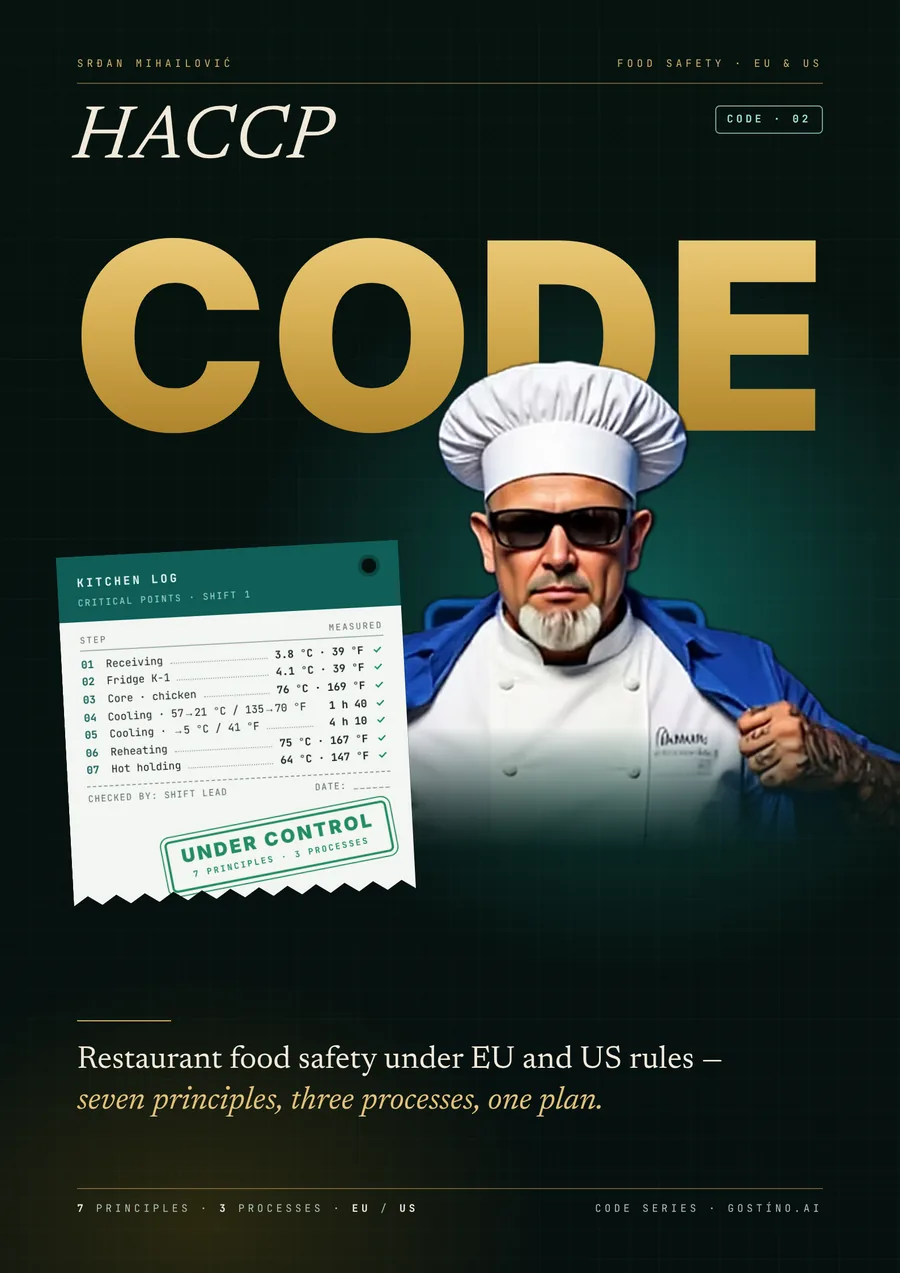
Cover of HACCP Code: the author in chef’s whites in front of large gold lettering reading CODE, with a temperature log card stamped Under control
Why this book

Same job. Two rulebooks.

Most HACCP books are written for factories and for one country. This one is written for the kitchen — and puts the European Union and the United States side by side. Where they agree, it says so once. Where they differ, it gives both, with a source for every number.

TopicEUUS
HACCPProcedures based on HACCP principles are mandatory for every establishment, with flexibility for small onesA formal HACCP plan only for special processes; active managerial control for everything else
TemperaturesThe hygiene regulation mostly sets no numbers — they come from Member States and their national guidesExact temperatures and times in the FDA Food Code
Allergens14, information mandatory for non-prepacked food too9, written notification for unpackaged food
Fish served raw−20 °C (−4 °F) for at least 24 h, or −35 °C (−31 °F) for at least 15 h−20 °C (−4 °F) for 7 days, or −35 °C (−31 °F) for 15 h (with conditions)
Raw on the menuNo specific menu note in these regulationsMandatory consumer advisory on the menu
InspectionRisk-based and, as a rule, unannouncedAt least once every 6 months, with deadlines for corrections

Sources: Regulations (EC) No 852/2004 and 853/2004, (EU) No 1169/2011 and 2017/625; FDA Food Code 2026. In detail, article by article — in Parts 2, 3 and 8.

What the book covers

Thirteen parts. From the regulation to the plan on the wall.

  1. 01

    What HACCP is — and what it isn’t

    The food safety house, seven principles, twelve steps.

  2. 02

    EU and US side by side

    Who writes the rules and when a HACCP plan is mandatory.

  3. 03

    All the regulations in one place

    Eleven EU regulations and the US model code — what applies to a kitchen.

  4. 04

    Good hygiene practice — the pillars of the house

    Premises, water, cleaning, pests, hands, the sick worker, receiving.

  5. 05

    What can make a guest sick

    Bacteria, viruses, parasites, toxins, chemicals, foreign objects, allergens.

  6. 06

    The seven principles, step by step

    Hazard analysis, the decision tree, limits, monitoring, records.

  7. 07

    Three processes — the whole menu in three flows

    Three flows instead of fifty plans for fifty dishes.

  8. 08

    All temperatures and times

    From receiving to reheating, with the legal force of every number.

  9. 09

    Special processes and situations

    Sous-vide, vacuum, smoking, steak tartare, buffets, catering, delivery.

  10. 10

    Food safety culture and training

    How to measure food safety culture and what each station needs to learn.

  11. 11

    Verification, inspection and crises

    Internal audit, guest complaints, suspected food poisoning, recalls.

  12. 12

    Acacia’s complete plan

    One restaurant’s filled-in HACCP plan, from the team to the signatures.

  13. 13

    Printable forms

    28 sheets — one page, one job, one signature.

  14. D

    Appendices

    Glossary, °C ↔ °F, a list of all regulations and an index of key numbers.
Look inside

Every number has a source. Every source has an article.

The regulations were read in their original text, not retold. Where a regulation says nothing, the book says so plainly. Click a page to see it full size.

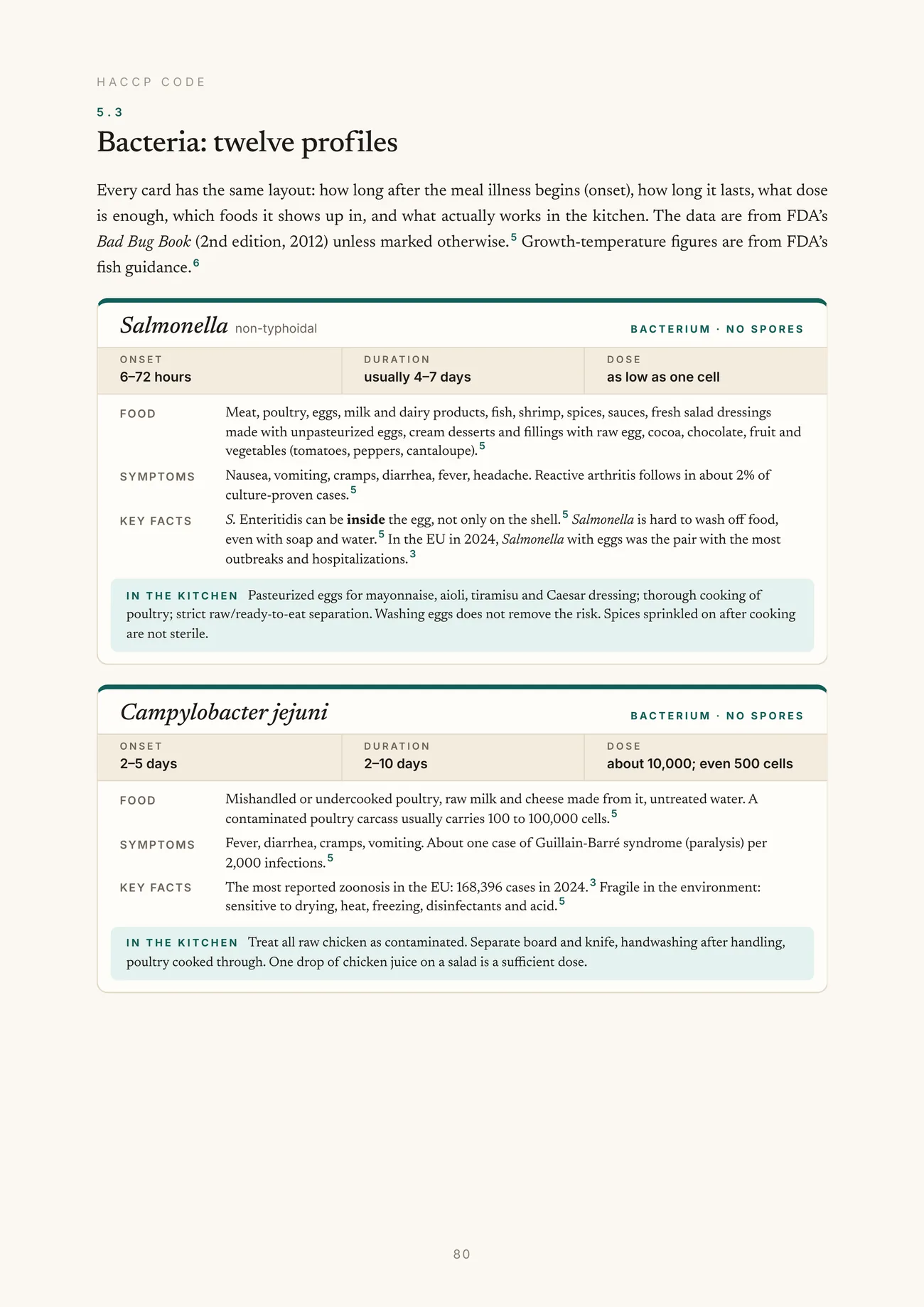
Page from Part 5: profile cards for Salmonella and Campylobacter
Part 5 · Bacteria profilesOnset, symptoms, foods and kitchen controls — for each one.
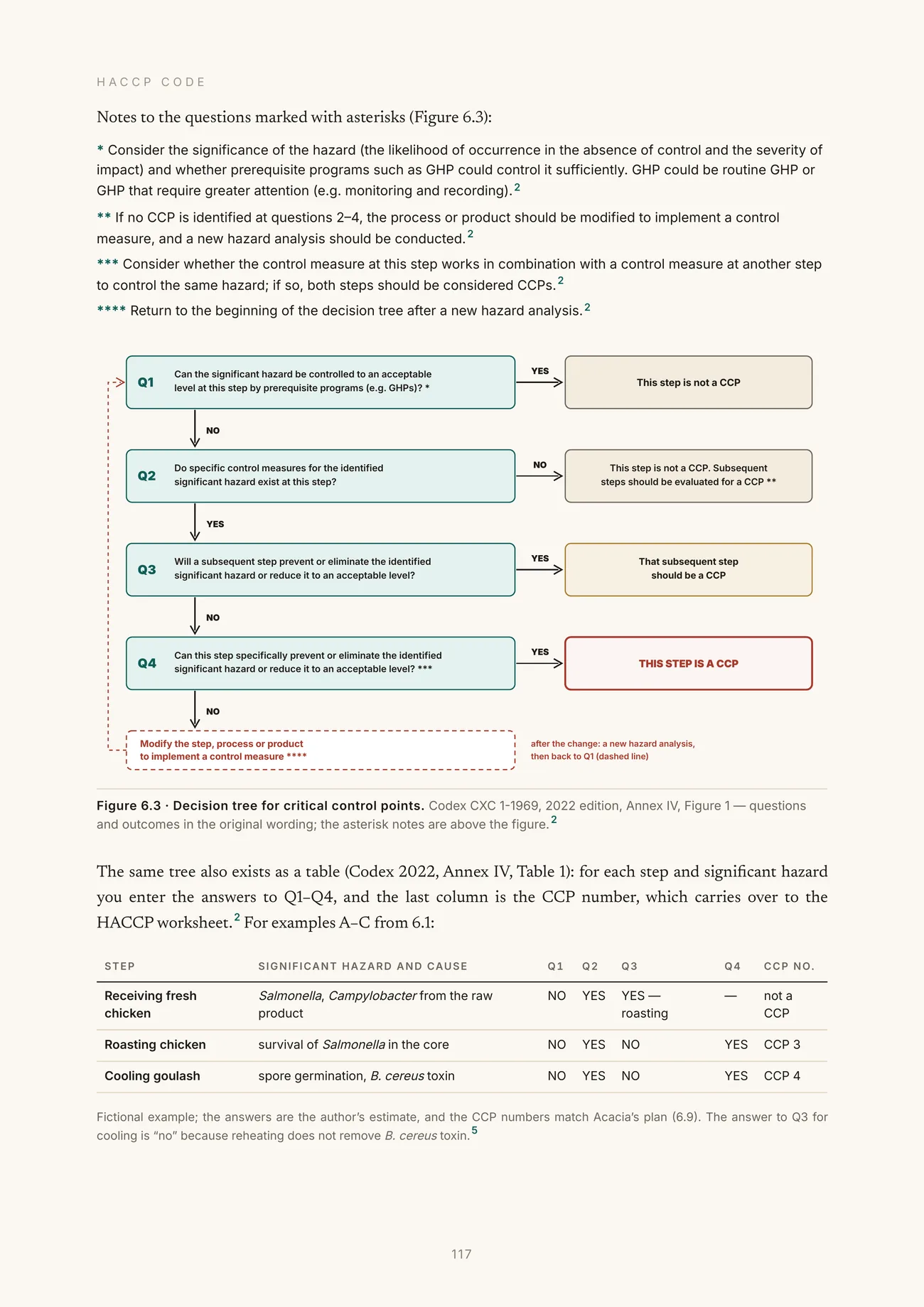
Page from Part 6: the decision tree for critical control points
Part 6 · Decision treeFour questions from the Codex Alimentarius: is this step critical?
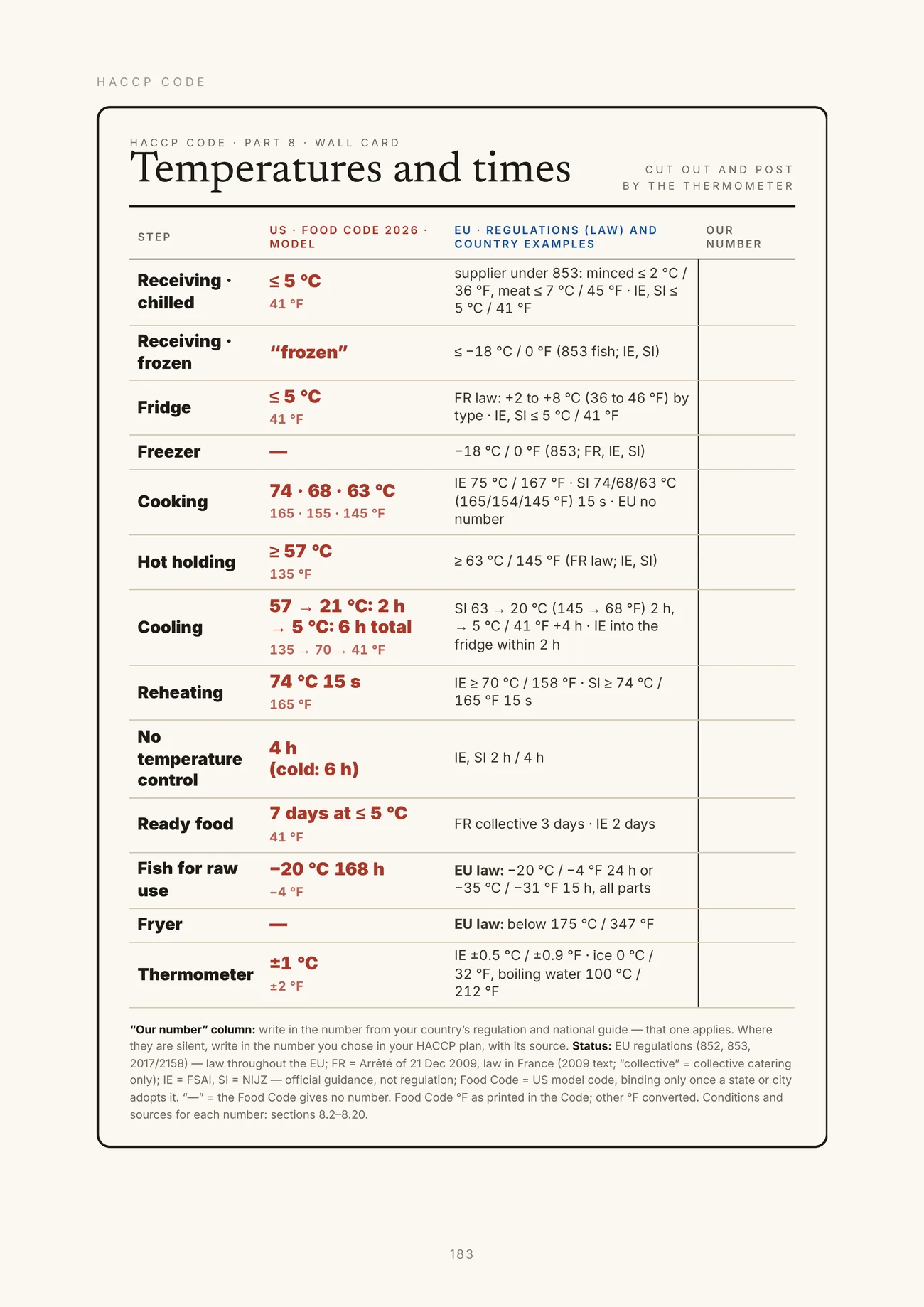
Page from Part 8: wall card with all key temperatures and times in °C and °F
Part 8 · Wall cardAll the key numbers on one page, each marked law, guidance or model.
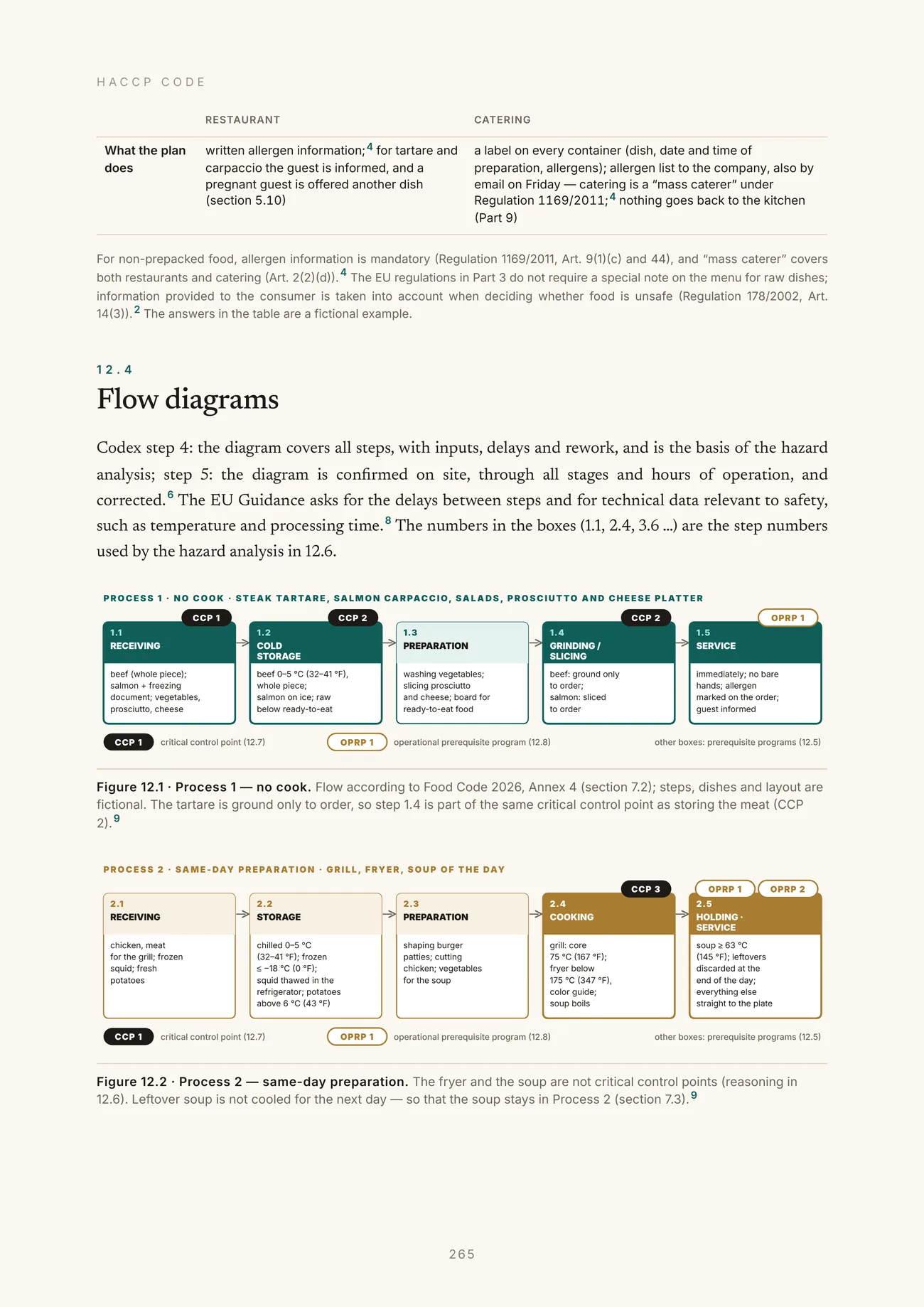
Page from Part 12: flow diagrams with critical control points in the plan of the Acacia restaurant
Part 12 · Acacia’s planFlow diagrams with critical control points, step by step.
From Part 8

The numbers a kitchen has to know by heart.

In the EU, most cooking, cooling and holding numbers are set by the Member States. In the US, they come from the Food Code. The book gives both — in °C and °F — and says how binding each one is.

74 °C165 °Fcore: poultry, stuffed foods · reheating to 74 °C (165 °F) for 15 s
68 °C155 °F17 s · ground meat and fish
63 °C145 °F15 s · fish, whole-muscle meat, eggs for immediate service
≥ 57 °C135 °Fhot holding
57 → 21 °C135 → 70 °Fcooling within 2 h, then to 5 °C (41 °F) — 6 h in total
≤ 5 °C41 °Fcold holding · ready-to-eat food for no more than 7 days
MODELApplies once a state, county or city adopts it.

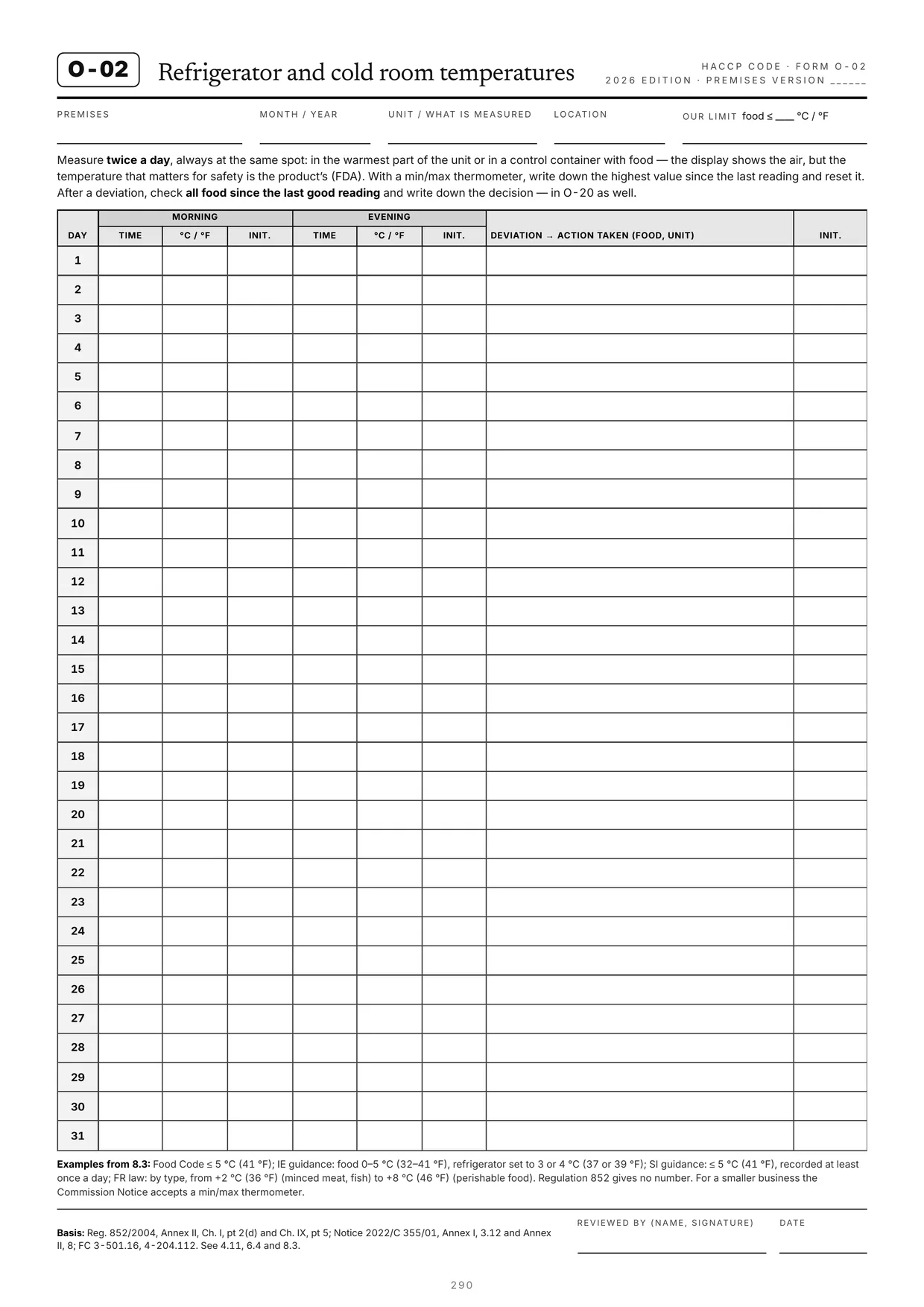
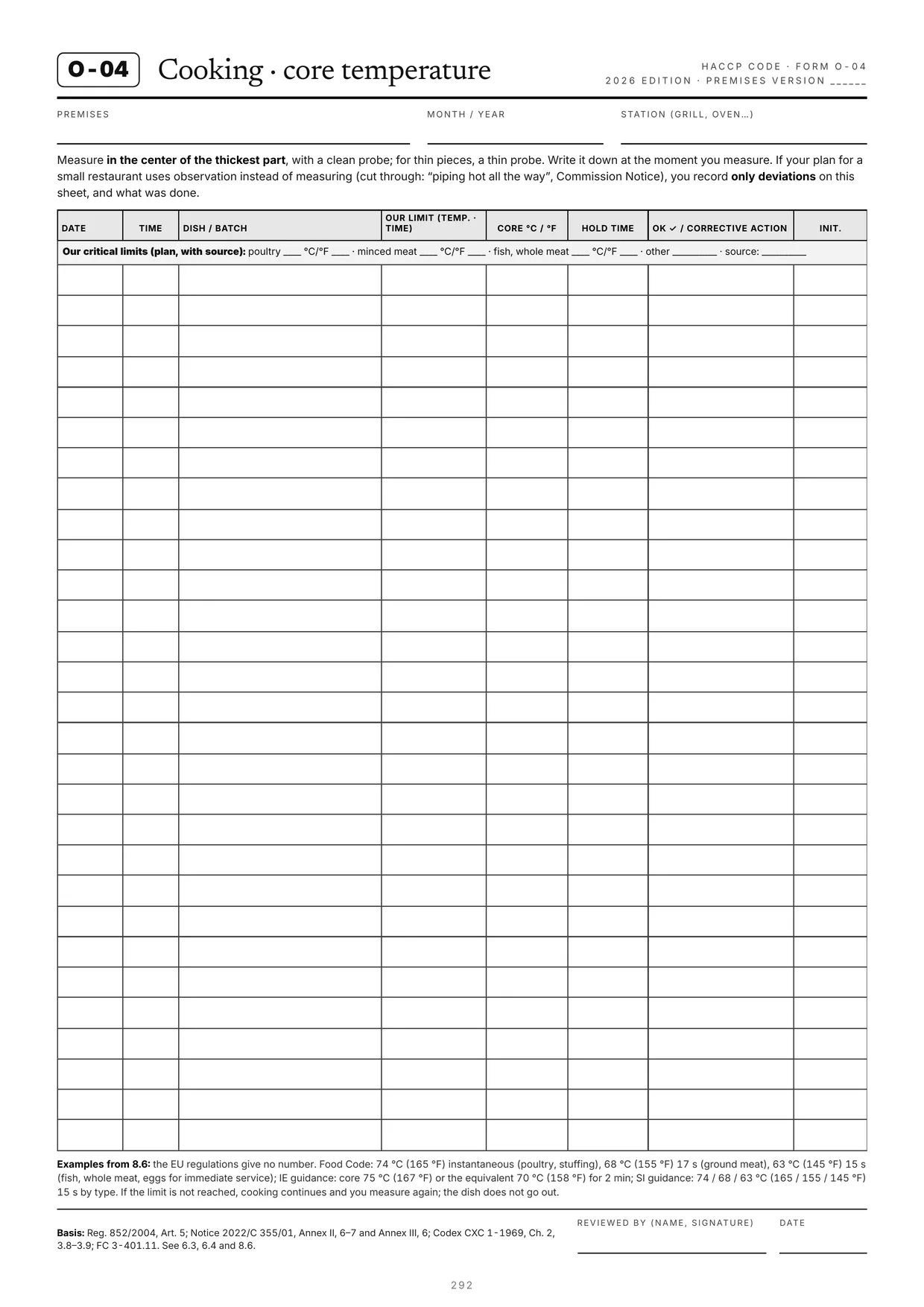
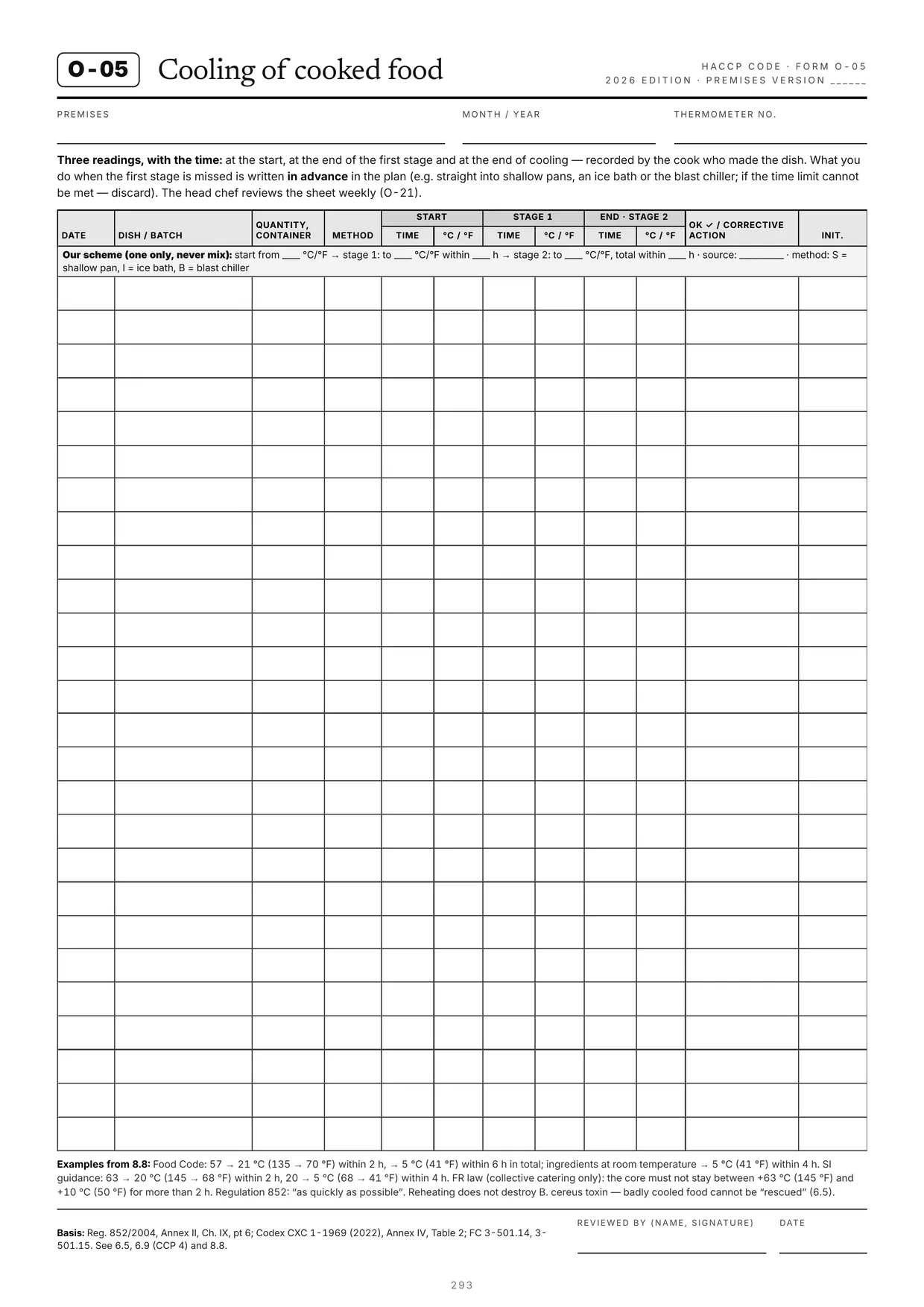
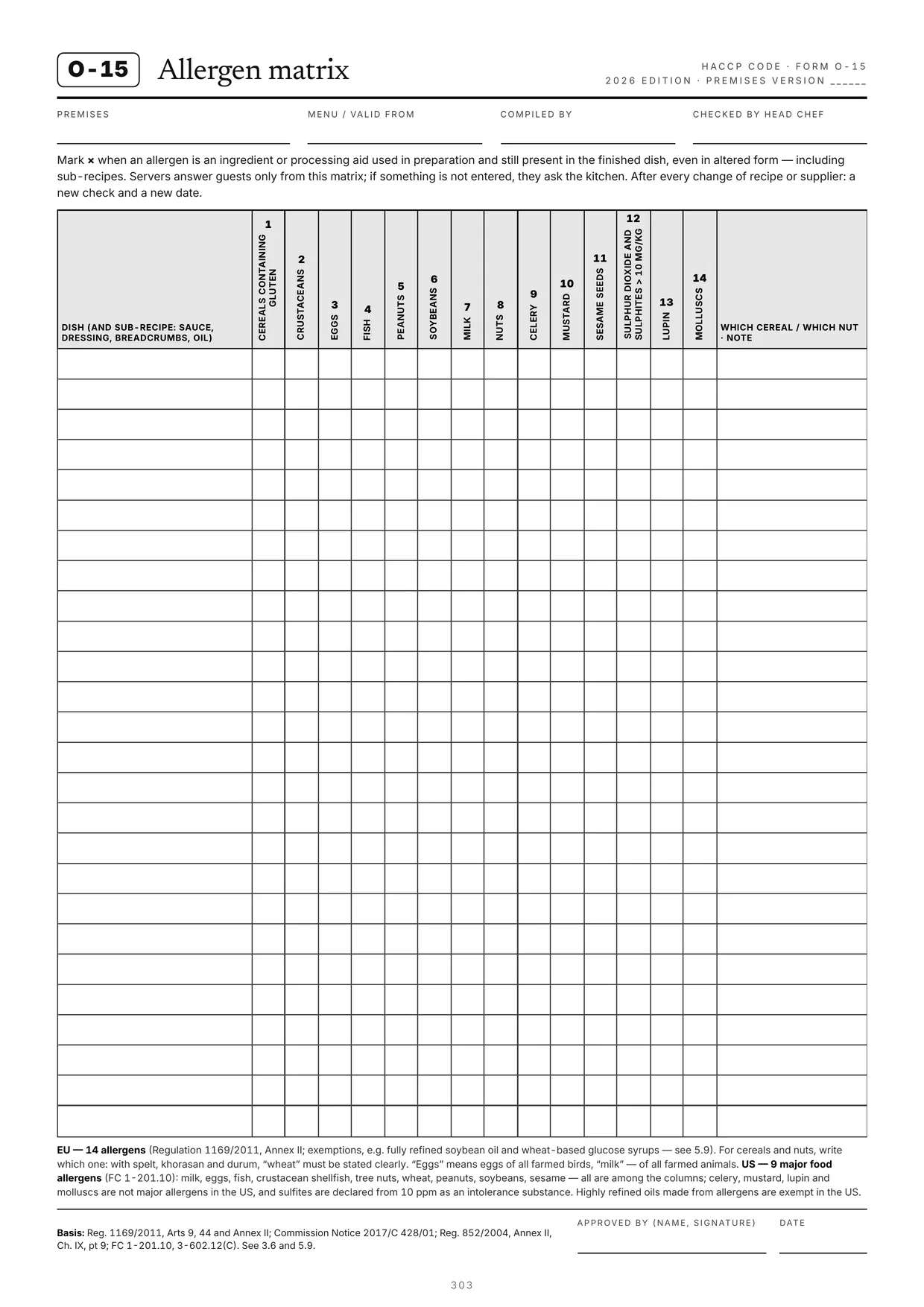
28 printable forms

One A4 page per job, black and white for printing. You write in the limits yourself — an empty field is better than an invented number. All of them also come as a separate PDF.

All 28 forms
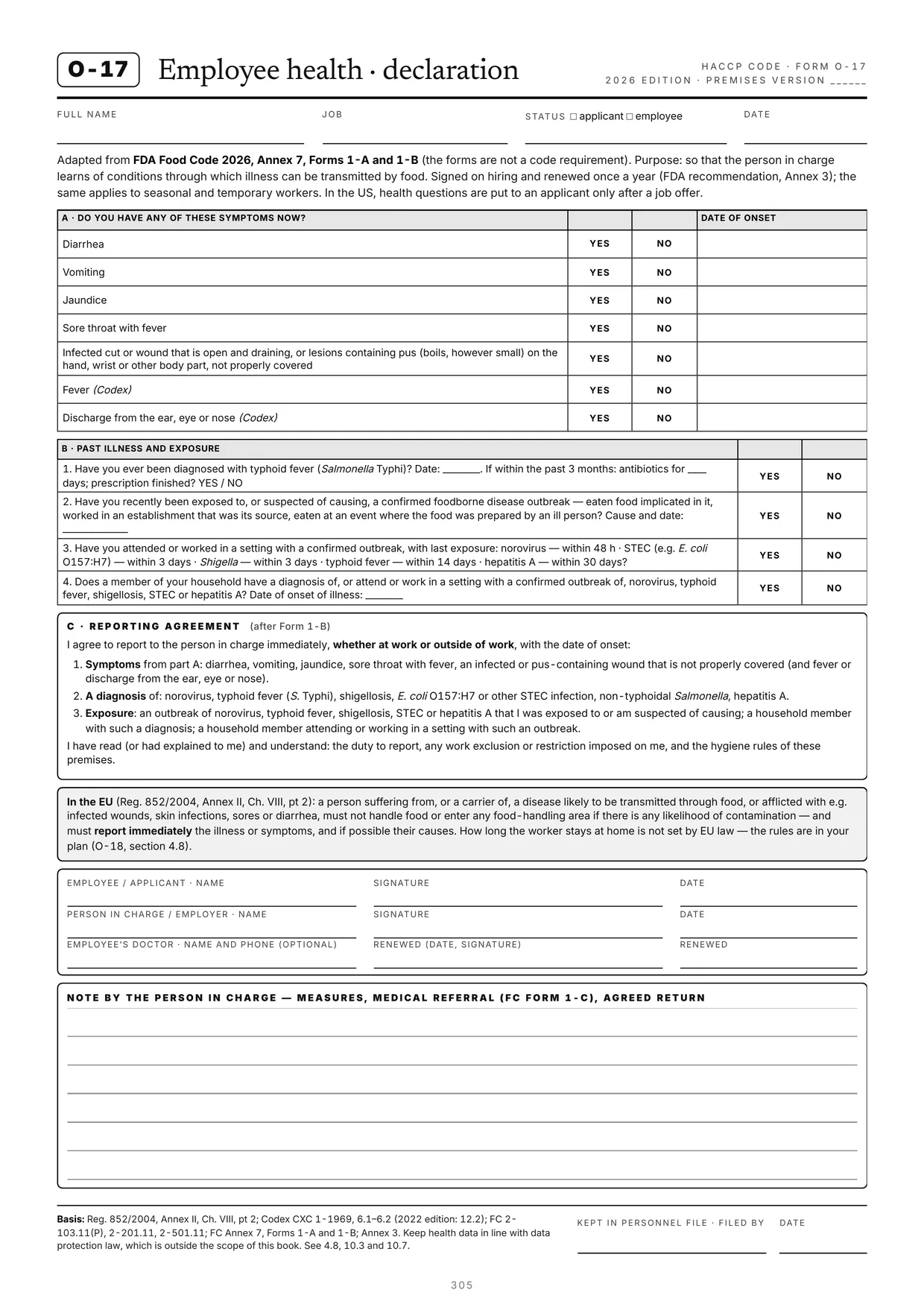
  1. O-01Goods receiving
  2. O-02Refrigerator and cold room temperatures
  3. O-03Freezer temperatures
  4. O-04Cooking · core temperature
  5. O-05Cooling of cooked food
  6. O-06Reheating for hot holding
  7. O-07Hot and cold holding · buffet
  8. O-08Time as a control
  9. O-09Freezing fish for parasite control
  10. O-10Sous-vide and cook-chill · batch
  11. O-11Cleaning schedule
  12. O-12Cleaning record · week
  13. O-13Pest control
  14. O-14Thermometer checks and calibration
  15. O-15Allergen matrix
  16. O-16Allergen in the order
  17. O-17Employee health · declaration
  18. O-18Illness and return to work
  19. O-19Training record
  20. O-20Corrective action log
  21. O-21Weekly verification
  22. O-22Internal audit of the HACCP plan
  23. O-23Guest complaint
  24. O-24Incident report
  25. O-25Recall and traceability
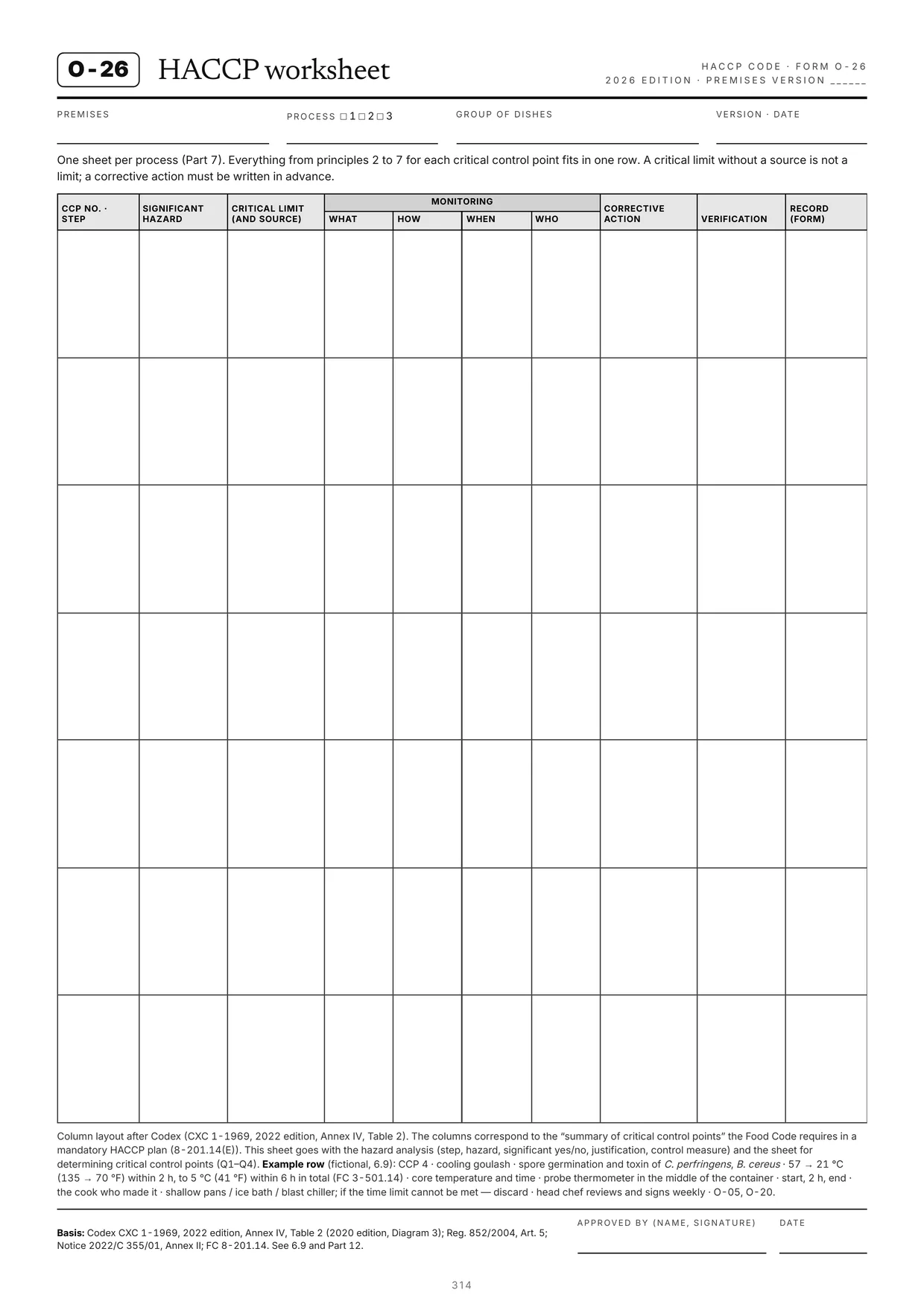
  26. O-26HACCP worksheet
  27. O-27Flow diagram
  28. O-28Fryer oil

Word template: “HACCP plan” for your premises

The same layout as Acacia’s plan in Part 12: team, product description, flow diagrams, prerequisite programs, hazard analysis, critical control point cards, verification and revision history. You fill in the gray fields — and the plan is yours.

Get the book

The book on its own or the whole system.

HACCP Code is sold on its own, and it also comes in the Empire package, together with Restaurant Code and a ready-made system for the whole team.

On its own

HACCP Code

The book and every tool for a HACCP plan under EU and US rules.

€39€27.30−30% for early buyers · one-time payment
  • The 327-page book as a PDF, 13 parts plus appendices
  • 28 forms in a separate PDF for printing on A4
  • A Word HACCP plan template you fill in for your own premises
  • You may print and adapt the forms for your own premises
Choose HACCP Code
All in one

Empire

Restaurant Code + HACCP Code + a ready-made system for the team.

€79€55.30−30% for early buyers · one-time payment
  • HACCP Code: the book, 28 forms and the Word HACCP plan template
  • Restaurant Code with all its forms, Excel workbooks and templates
  • Operations manual and a handbook for new staff
  • Wall pack: A3 posters · license for multiple locations
See the Empire package

Checkout is through Gumroad: once you pay, the download link arrives in your inbox right away. Gumroad opens soon — until then, this page is a preview of the book.

Who the book is for

For the people who answer for the food on the plate.

This book is for you if

  • you run a restaurant, hotel kitchen, catering business or café in the EU or the US
  • you are a head chef or manager who writes or runs the HACCP plan
  • you have a plan in a binder, but the kitchen doesn’t use it
  • you are opening a place and want a system in place before the first inspection

This book is not for you if

  • you want a ready-made plan you just sign
  • you run a food factory — this book is written for food service kitchens
  • you need legal advice on a specific dispute — that is a job for a lawyer or consultant
Srđan Mihailović in chef’s whites and toque
About the author

Srđan Mihailović

More than thirty years in hospitality: in top hotel kitchens and restaurants and on cruise ships. He has worked and lived on four continents and knows both sides of the business — the one at the stove and the one at the owner’s desk.

He is the founder of Gostíno.ai. HACCP Code is the second book in the CODE series, after Restaurant Code.

Questions

Before you start

What format is the book?

A 327-page PDF for phone, tablet and computer. The forms also come as a separate PDF for printing on A4, and the HACCP plan is a Word template that also opens in Google Docs and LibreOffice.

Can I buy just HACCP Code?

Yes. The book with the forms and the Word HACCP plan template costs €39; early buyers pay €27.30. The same book also comes in the Empire package, together with Restaurant Code and a ready-made system for the whole team.

What language is it in?

English. Every temperature is given in both °C and °F. A Serbian edition, HACCP kod, is also available.

Does it apply outside the EU and the US?

The book covers the rules of the European Union and the United States. The seven HACCP principles are the same in the Codex Alimentarius, in EU law and in the US guidelines — only the wording differs. Your premises are always governed by the law of the country where you operate.

How up to date are the regulations?

Every regulation was read in its original text. The date of the version used is given with each source; the latest consolidated text is from 19 August 2026.

Is this legal advice?

No. The book explains the regulations and shows the method. Your premises are governed by the law of your country and the decisions of your inspectors.

Are the examples from a real restaurant?

No. Acacia is a fictional restaurant. Its plan shows the method from start to finish, and every number in the plan has a source and a legal-force label.

A plan the kitchen actually uses.

Three processes instead of fifty recipes. Five critical control points instead of thirty. Logs filled in at the moment of measuring.