Book 1AVAILABLE

The Choice Algorithm
Menu psychology and architecture: how guests choose, how a menu is put together and how a change to it is measured.
Menu maths: food cost, standard recipes, pricing and stock — and exactly where the money goes.
The first book explains how guests choose, the second what every dish really costs and earns, the third how software runs all of it for you. Each one also stands on its own.
Menu psychology and architecture: how guests choose, how a menu is put together and how a change to it is measured.
Menu maths: the recipe card to the cent, yield, sub-recipes, portions, purchasing, pricing with VAT, drinks, stock and the monthly reconciliation.

The menu in the digital world: QR menu, allergen matrix, till and kitchen screen as one system — with one source of truth, one order id and a human for every critical decision.
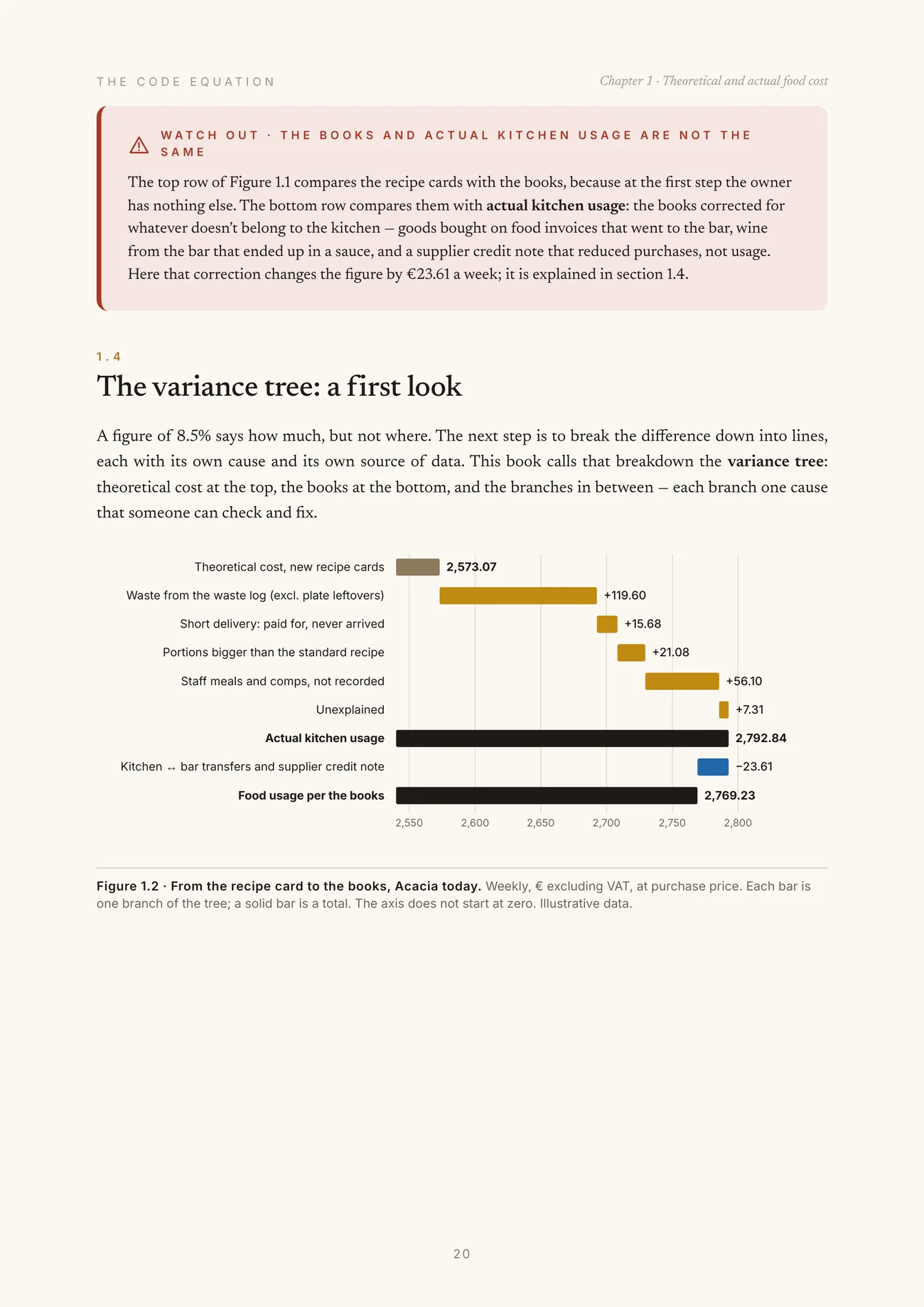
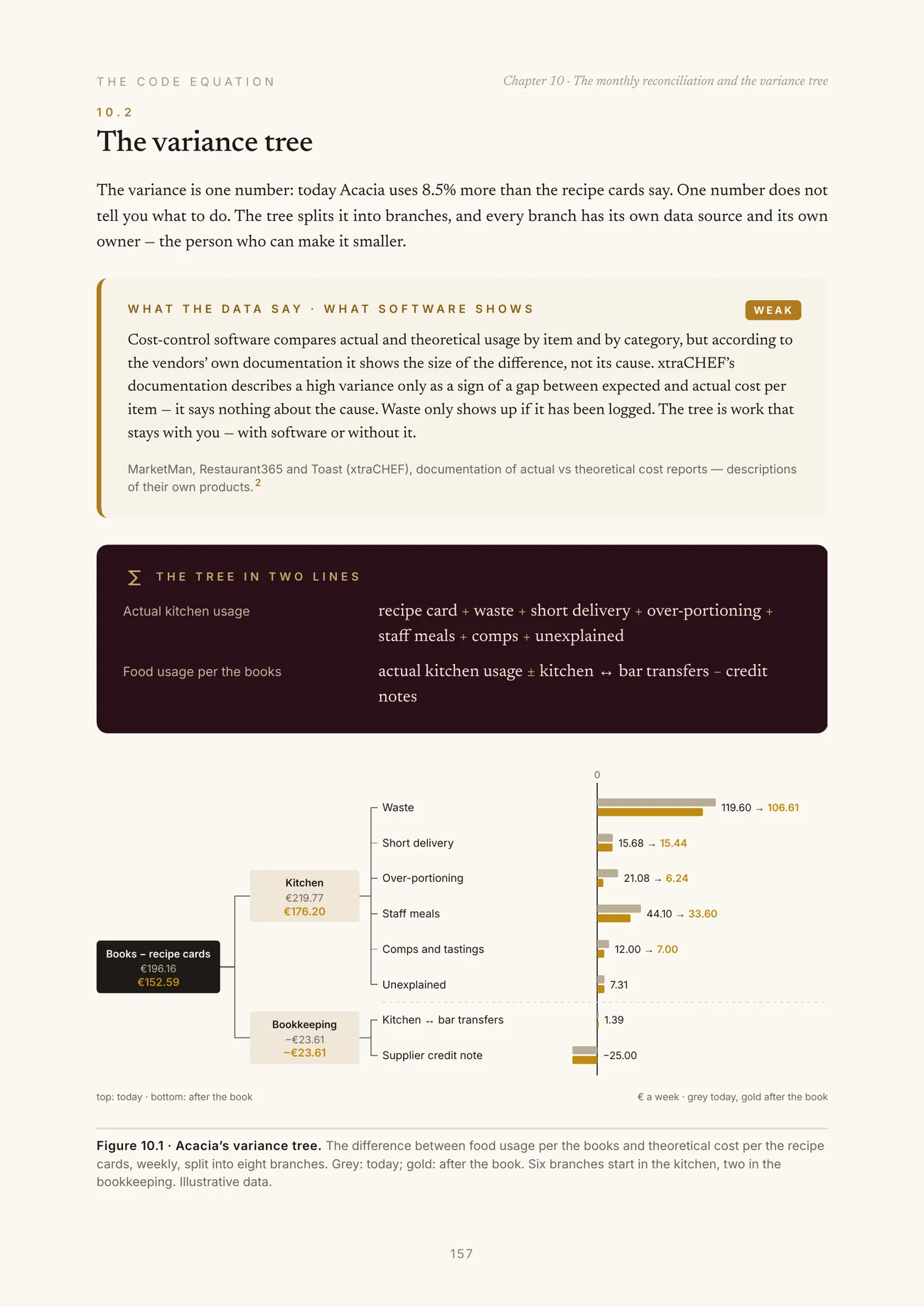
Inventory software shows how far actual cost is above the recipe cards, but not why. The Code Equation breaks the gap into branches — waste, deliveries, portions, purchasing, the bar, stock, staff meals — and for every claim says how well it has actually been measured, with its source. Where there is no evidence, it says so.
Three parts: where the money goes, purchasing and price, stock and reconciliation. Every chapter has a number you measure, forms, one restaurant’s example with every figure shown, and the rules for Serbia and Croatia — VAT for other countries too — with their source and date.
| No. | Chapter | The number you measure | Forms in the book |
|---|---|---|---|
| 01 | Theoretical and actual food cost | variance of actual from theoretical food cost, % | Monthly food cost equation · Variance tree — first look |
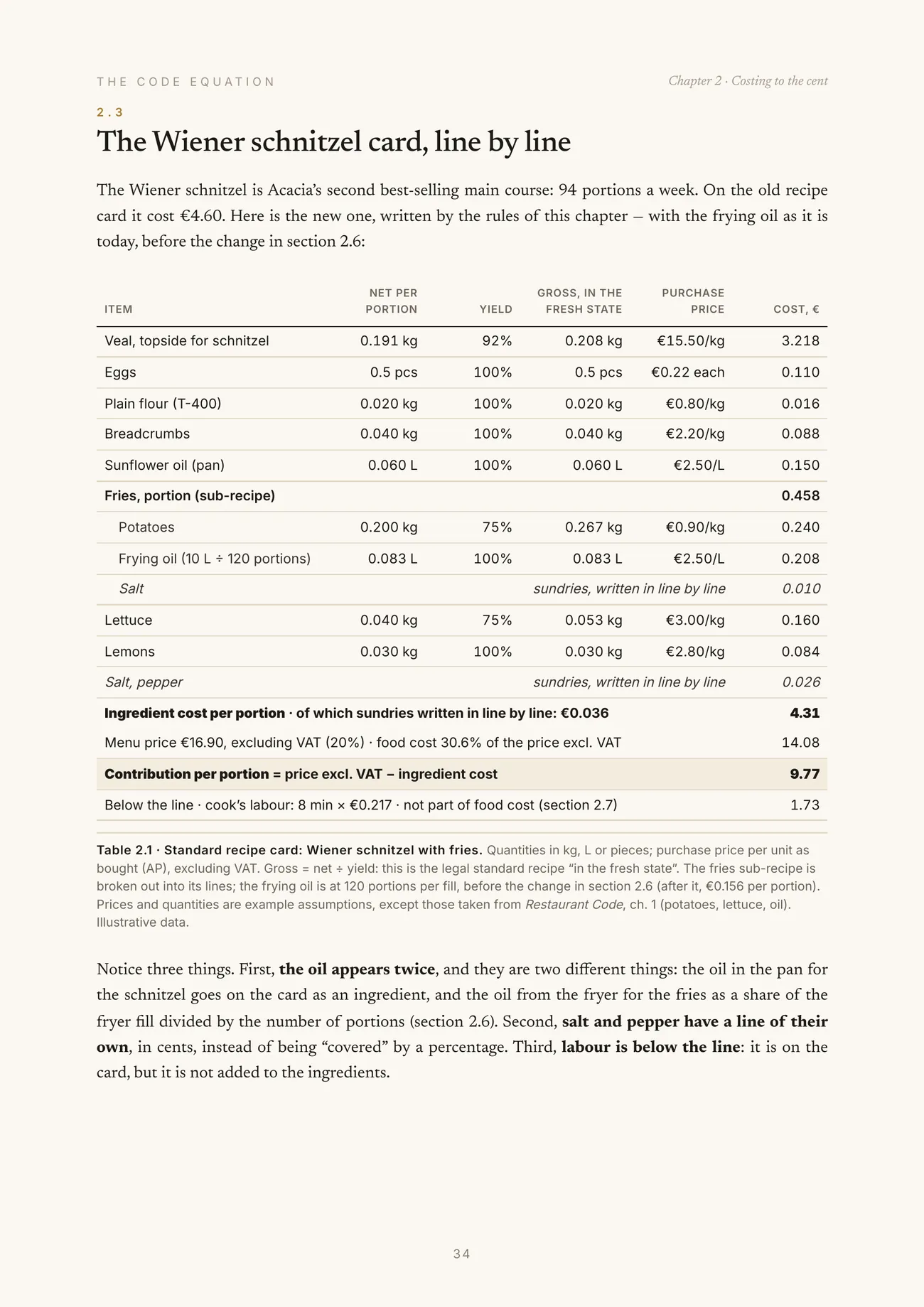
| 02 | Costing to the cent | dishes with an up-to-date recipe card | Standard recipe card · Breaking down an old recipe card |
| 03 | Yield | price of portioned rump steak, €/kg | Yield test (butchering) · Cooking loss test |
| 04 | Sub-recipes | share of broth from your own house stock, % | Sub-recipe card · Recipe chain (dish tree) |
| 05 | Portions that hold | over-portioning (excess over the standard), € | Portion control at the pass · Portion specification |
| 06 | Suppliers and ingredient prices | saving on class A, € | ABC purchasing analysis · Comparing quotes by trimmed price |
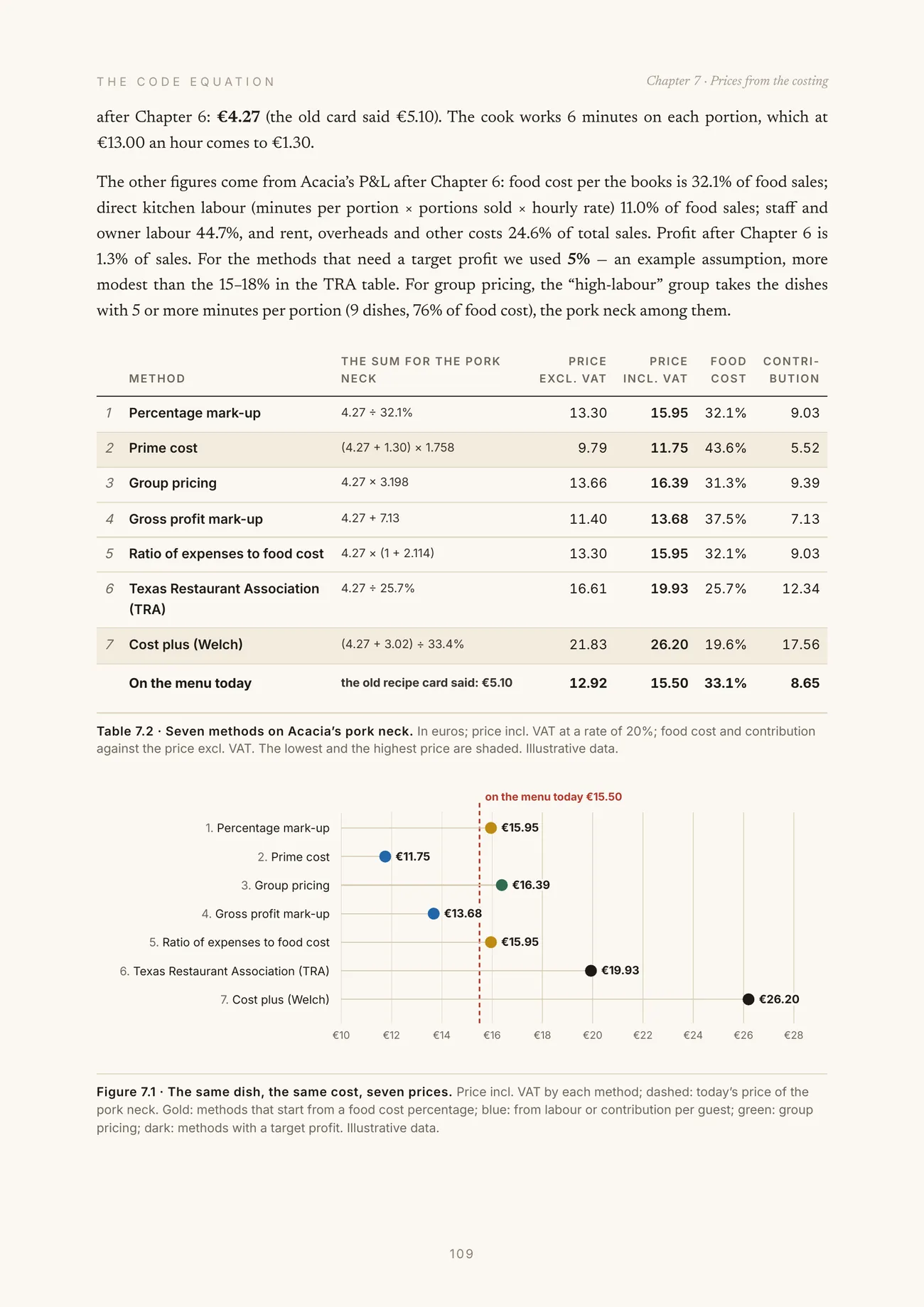
| 07 | Prices from the costing | dishes whose price does not follow the recipe card | Price by seven methods · Price with VAT for your country |
| 08 | Drinks | bar variance, % | Drinks costing: bottle → glass · Weekly bar check |
| 09 | Stock | stock past its use-by date, € | Stock count by ABC and valuation · Par, reorder point and shelf life |
| 10 | The monthly reconciliation and the variance tree | staff meals and comps, € | Monthly food and drink cost reconciliation · Variance tree |
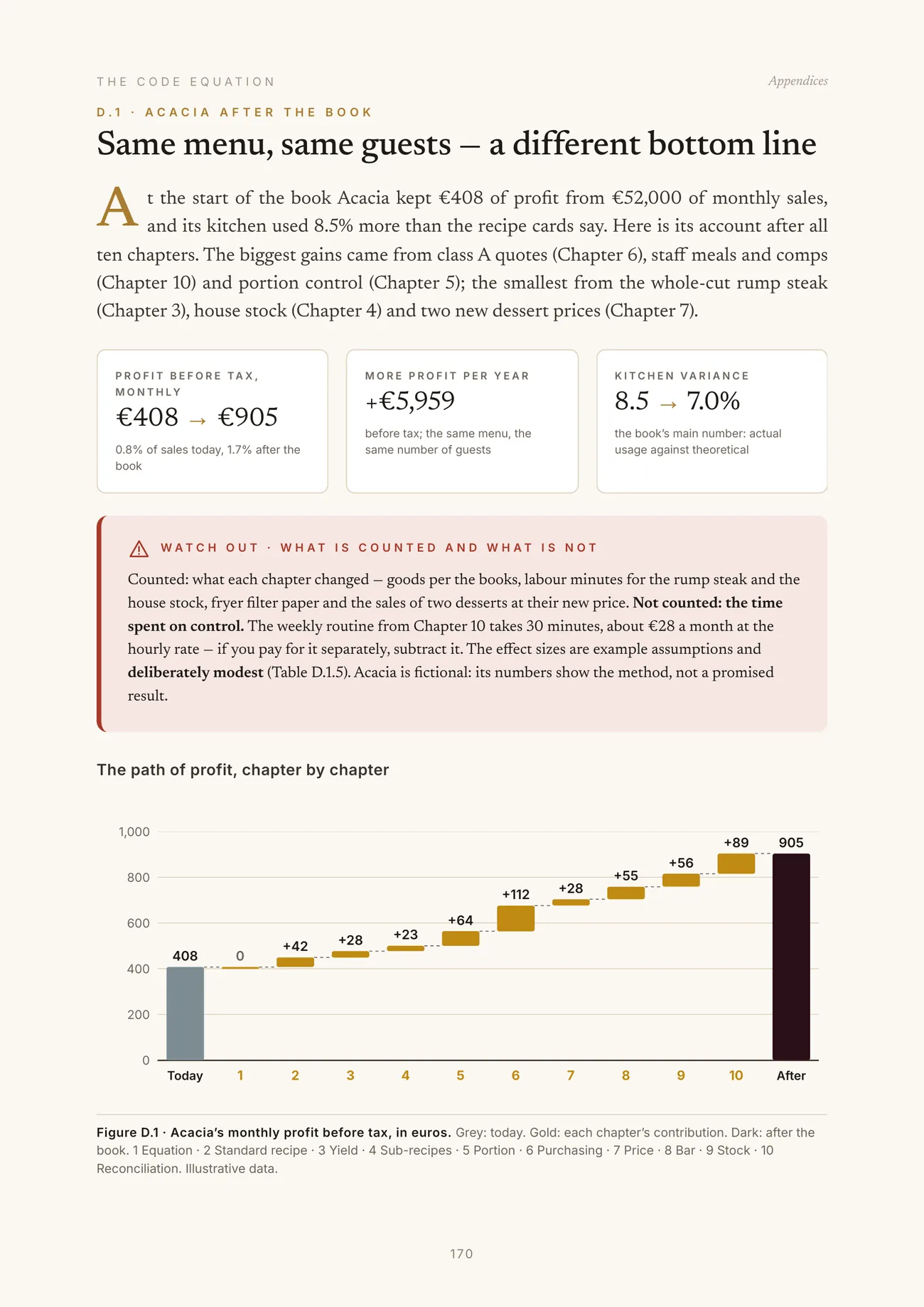
Acacia, a restaurant we made up, starts with old recipe cards: the previous chef added “+10% for loss and sundries” to each one, at old prices. Once the cards are corrected, actual kitchen usage is 8.5% above theoretical — €219.77 a week. Chapter by chapter, the book gives every euro of that gap a name: the variance falls to 7.0%, and profit before tax rises from €408 to €905 a month.
Each book of the trilogy is one product: the book with every form, workbook, template, poster and video guide that goes with it. Nothing to add on.
The book and every resource with it, for your business and your team.
The workbooks run in Excel (2019 or newer), Google Sheets and LibreOffice; the templates in Word, Google Docs and LibreOffice.
Each book costs €39. All three together cost €99 instead of €117 — you save €18. All three books are out; if you have already bought one or two, you only pay the difference for the set.
Purchases go through Gumroad. After payment, the download link arrives in your inbox straight away.

More than thirty years in hospitality: in top hotel kitchens and restaurants, and on cruise ships. He has worked and lived on four continents and knows both sides of the business — the one at the stove and the one at the owner’s desk.
He is the founder and owner of Gostíno.ai, an agency that helps hospitality businesses run their work with digital tools.
The same job is bound by the same problems everywhere.
A 191-page PDF, 2026 edition. It reads on a phone, a tablet and a computer. The printable forms are A4; the forms you fill in on screen come in A4 and US Letter.
British English. There is also a Serbian edition, Jednačina koda.
No. The Code Equation stands on its own. If you have the other two, you will recognise Acacia: the same restaurant and the same starting point, €408 profit a month. A short box in Chapter 1 explains what the corrected recipe cards change in the sums of Book 1.
The method works everywhere: the recipe card, yield, portions, stocktake and reconciliation are the same in every kitchen. The rules on standard recipes, stocktakes and write-offs are given for Serbia and Croatia, and restaurant VAT rates for other countries too — with their source and as of October 2026. The book is not legal or tax advice: check with your accountant before you decide.
Everything: printable and fillable forms, Excel workbooks and the Acacia workbook, Word templates, AI prompts, the monthly review kit, wall posters and video guides. Nothing to add on.
Each book costs €39; all three together cost €99. All three books are out. If you have already bought one or two, you only pay the difference up to €99.
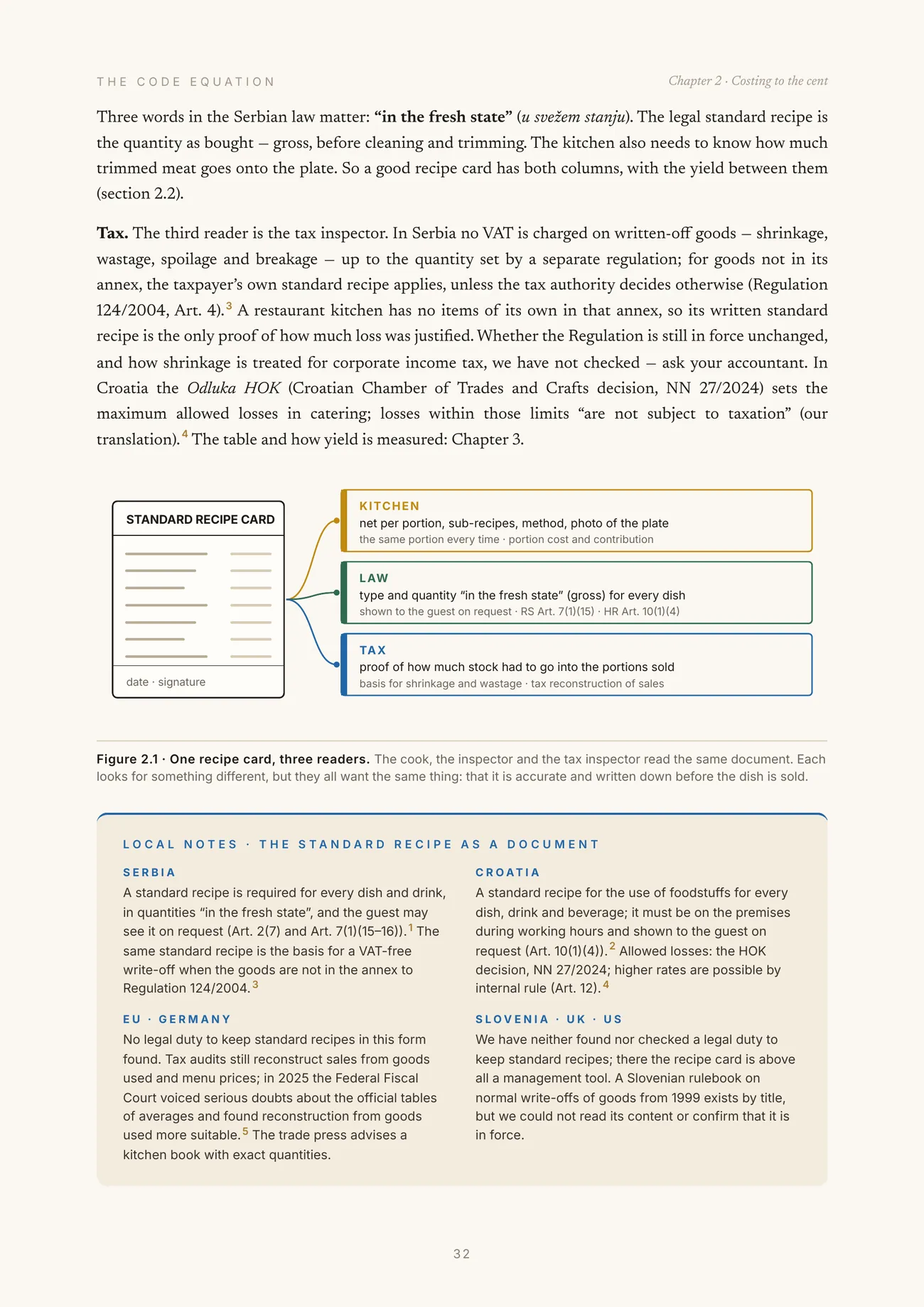
Every claim says how well it has been measured: strong, moderate, weak, myth, unreliable or not verified. The grade goes to the claim, not to its author; the table of every claim is in Appendix D.2.
No. Acacia is a restaurant we made up, the same from the first page to the last. Its numbers show the method; they don’t promise a result. Every fact from research and regulation has its source at the end of the chapter.
Yes: The AI Ecosystem — QR menu, allergen matrix, POS and KDS as one system. In Chapter 19 the recipe card from this book works inside the system.
Purchases go through Gumroad. After payment, the download link arrives in your inbox straight away.

Next month, the same branch has to be smaller.