PAGE PREVIEW · purchase links go live when Gumroad opens
GGostíno Srpski Get the book
Menu Trilogy · Srđan Mihailović

The ChoiceALGORITHM

Menu psychology and architecture: what research actually proves — and how a menu leads guests to the dishes that earn you most.

191pages, PDF
10chapters, from the guest’s choice to a test in your own dining room
19forms to print and to fill in on screen
6evidence grades, one on every claim
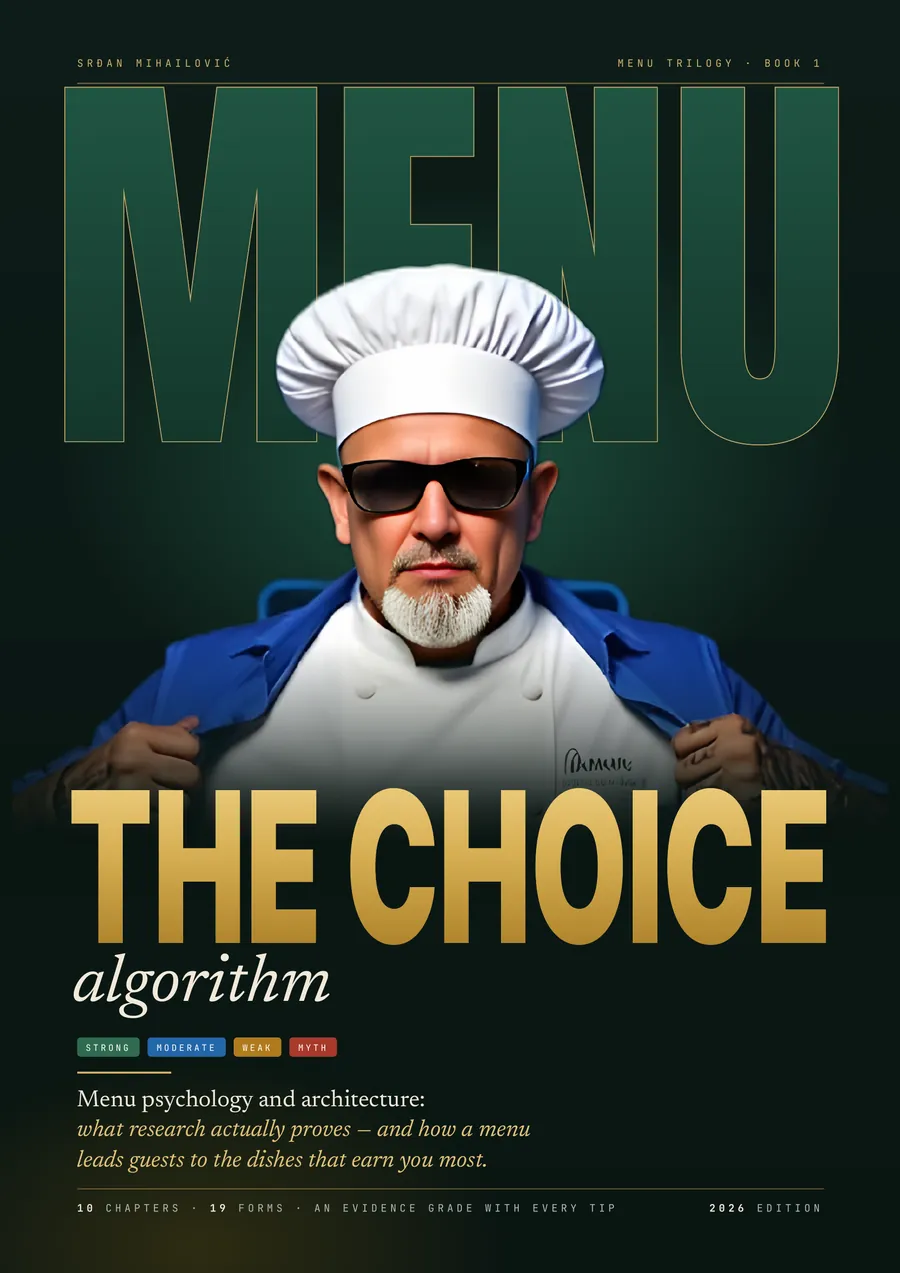
Cover of The Choice Algorithm: the author in chef’s whites and toque in front of large lettering reading MENU, with the title THE CHOICE algorithm in gold below
The Menu Trilogy

Three books. One menu that works for you.

The trilogy takes a menu from a plain price list to a smart tool for making money. The first book explains how guests choose, the second what each dish is really worth, the third how software runs it all for you. Each book also stands on its own.

1 · The guest choosesMenu psychology and architecture
2 · The numbers decideCost, margin, recipe specs, stock
3 · Software runs itQR menu, allergens, till and kitchen
Book 1AVAILABLE
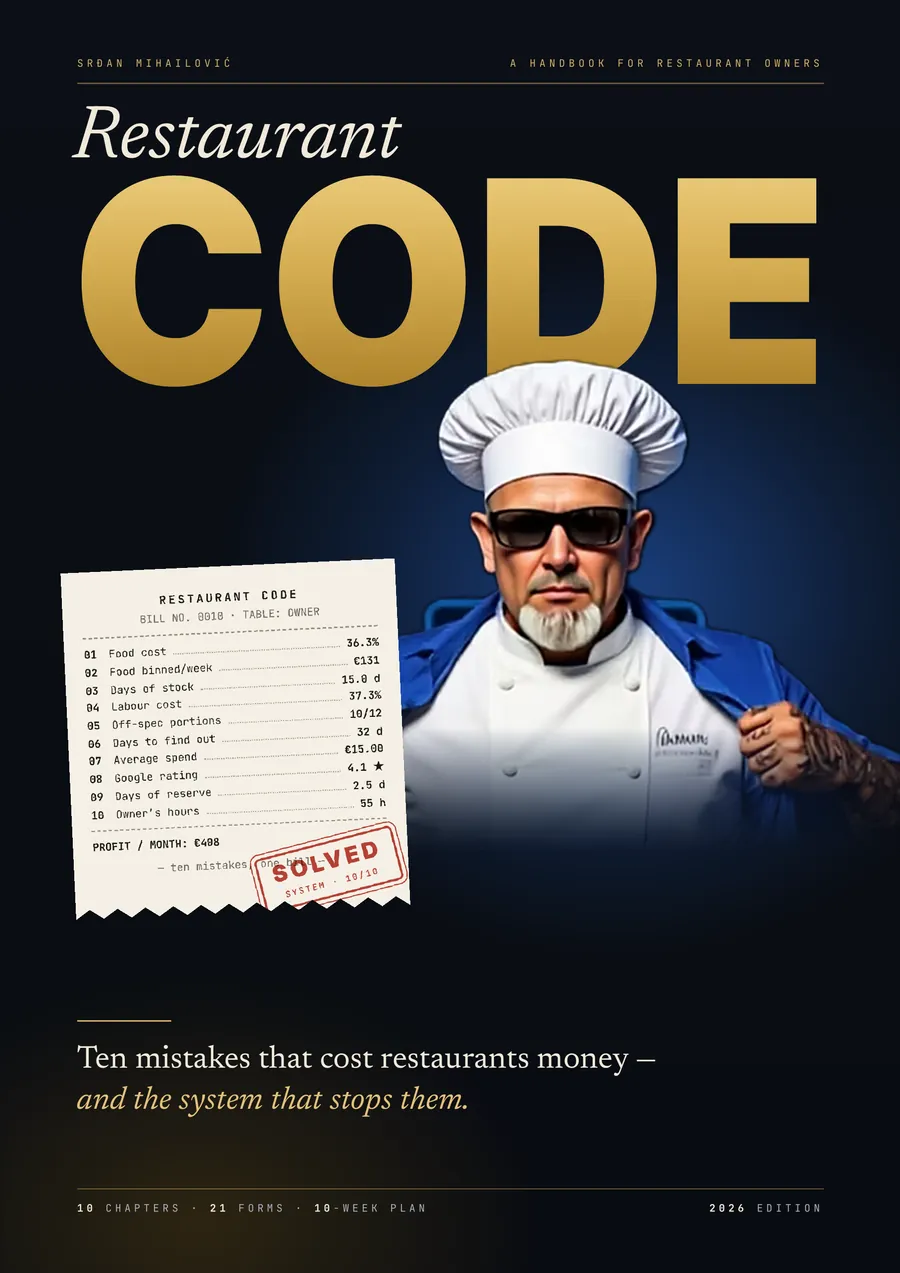
Cover of The Choice Algorithm

The Choice Algorithm

Menu psychology and architecture. Menu engineering, price psychology, the decoy effect and menu layout — with an evidence grade for every piece of advice.

Book 2AVAILABLE
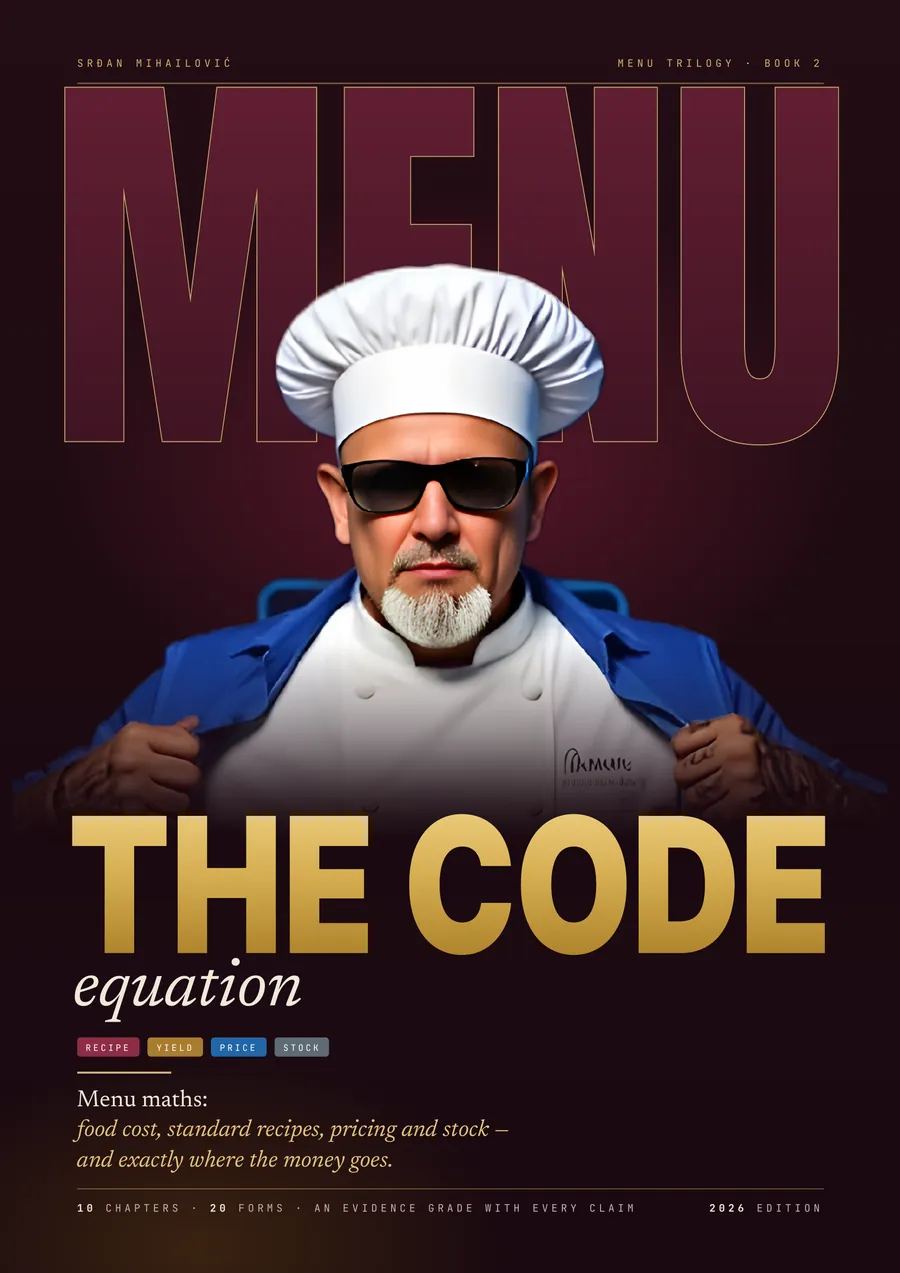
Cover of The Code Equation

The Code Equation

Menu maths: food cost, recipe specifications, pricing and stock — and exactly where the money goes. Costing to the cent, yield, purchasing, pricing with VAT, drinks, stock and the monthly reconciliation.

Book 3AVAILABLE
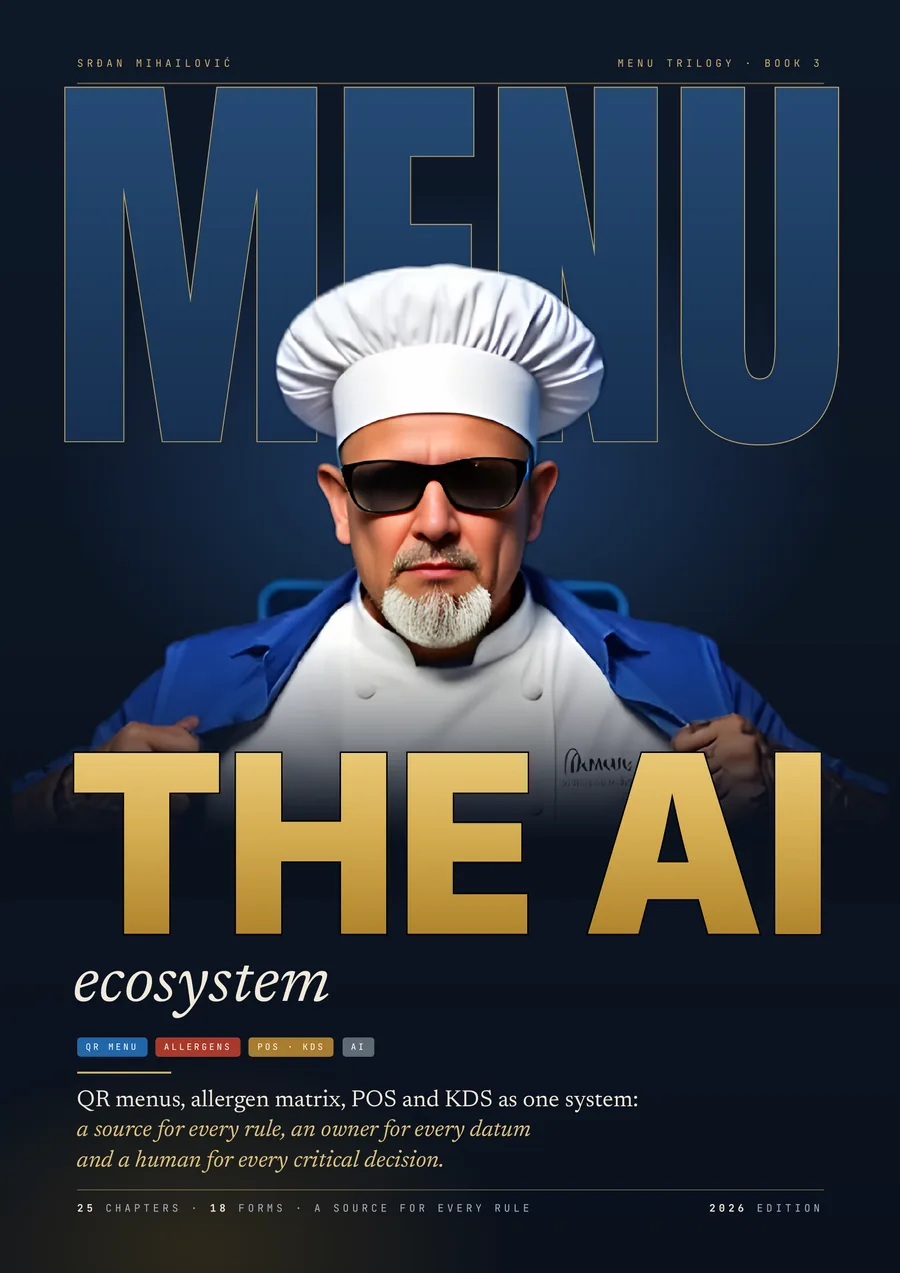
Cover of The AI Ecosystem

The AI Ecosystem

The menu in the digital world: QR menu, allergen matrix, till and kitchen screen as one system — with one source of truth, one order id and a human for every critical decision.

What makes it different

Every claim with its evidence grade.

Menus attract plenty of talk and very little measurement. Till-system blogs and consultants still copy figures from studies that don’t hold up. The Choice Algorithm says, for every claim, how well it has really been measured, and gives the source — and where there is no evidence, it says so.

STRONGMODERATEWEAKMYTHUNRELIABLENOT VERIFIED— six grades, the same throughout the book
The “most popular” label — when it’s trueCai, Chen and Fang, 2009 · field experimentSTRONG
A default option steers the choiceBoronowsky et al., 2022STRONG
Names that stress taste get more people choosing vegetablesTurnwald et al., 2017 and 2019STRONG
Listing prices from high to low leads to pricier choicesSuk, Lee and Lichtenstein, 2012MODERATE
A box around a dish lifts its salesReynolds et al., 2005; Kincaid and Corsun, 2003WEAK
Prices without the € sign raise the billYang, Kimes and Sessarego, 2009WEAK
The “sweet spot” at the top rightYang, 2012 · eye trackingMYTH
The second-cheapest wine carries the biggest marginde Meza and Pathania, 2021 · 470 wine listsMYTH
“Descriptive names lift sales by 27%”Wansink et al., 2001UNRELIABLE
Four-box menu analysis raises profitno before-and-after study foundNOT VERIFIED
Book 1 · contents

Ten chapters. Ten numbers to track.

Three parts: how guests choose, the architecture of the offer, and drinks plus testing in your own dining room. Every chapter has a number you measure, forms, one restaurant worked through with every figure, and the rules for the EU, the UK, the US and Serbia where they differ.

No.ChapterThe number you measureForms in the book
01How guests really choosefood contribution per guest, € excl. VATObservation at the table · The key number: contribution per guest
02Ten menu mythsmenu elements based on a mythMyth check on your menu
03Menu engineering that counts everythingweighted contribution margin, main courses, €Menu analysis with labour minutes · Decision per dish
04How many dishes, and which sectionsingredients used in only one dishIngredient map · Section structure and price range
05Prices guests acceptmain courses below the target contributionPrice ladder for a section · Price change plan
06Layout and design: paper, board, screen, platformstars and puzzles as a share of main-course sales, %Menu layout sketch · Readability checklist
07Words and labels that sellvegetable side, portions a weekNames and descriptions workshop · Labels and allergens
08Choices that guide themselvesdesserts per 100 guestsDefaults and bundles plan · Boundary check: guidance or deception
09The drinks and wine listdrinks contribution per guest, €Drinks list analysis · Wine list price range
10Your restaurant is a laboratorymenu changes decided by a test, %Test plan · Test and decision log
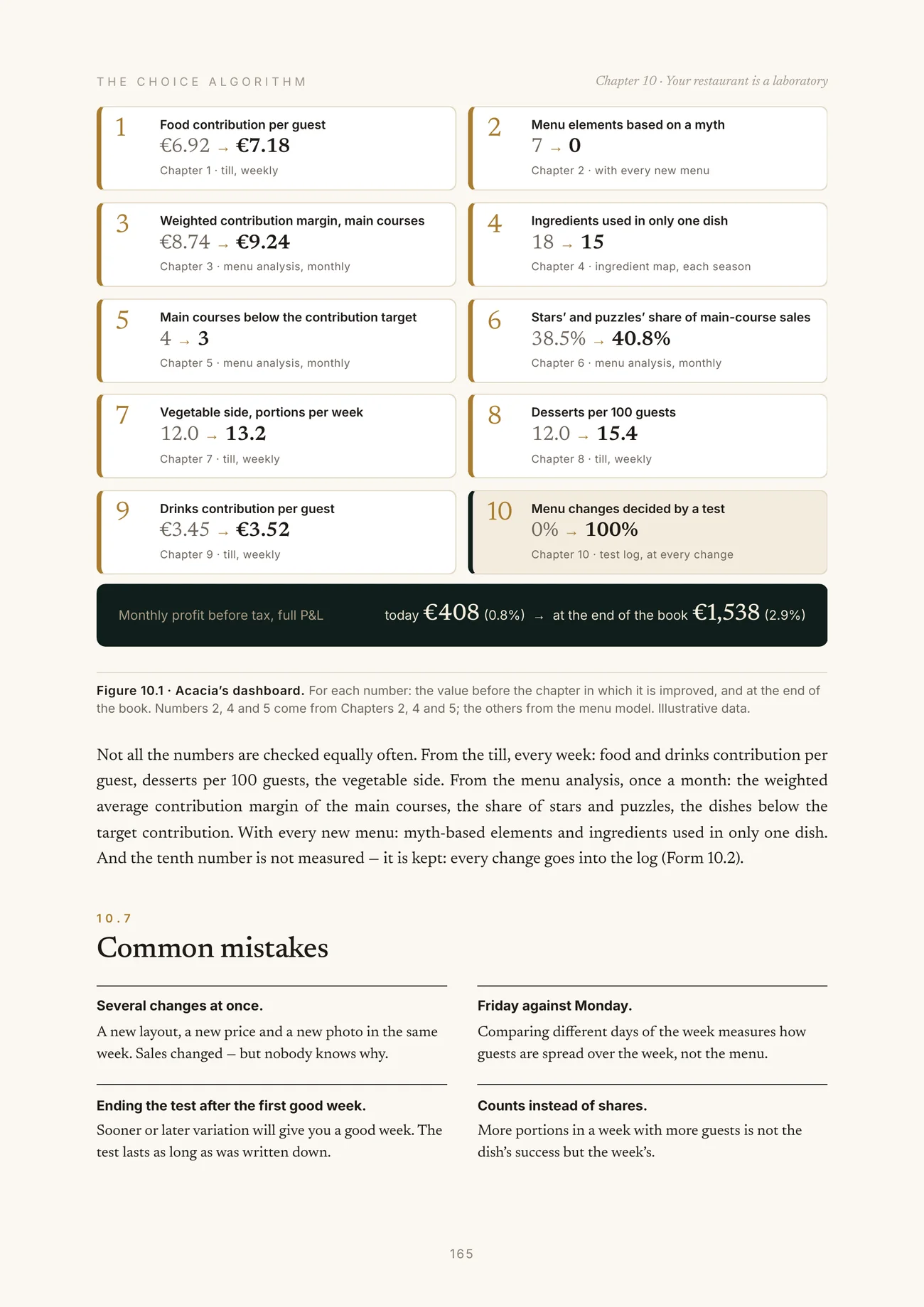
10 chapters · 10 numbers · 19 formsAcacia: profit €408 → €1,538 a month, from the menu alone
Look inside

One restaurant, every number.

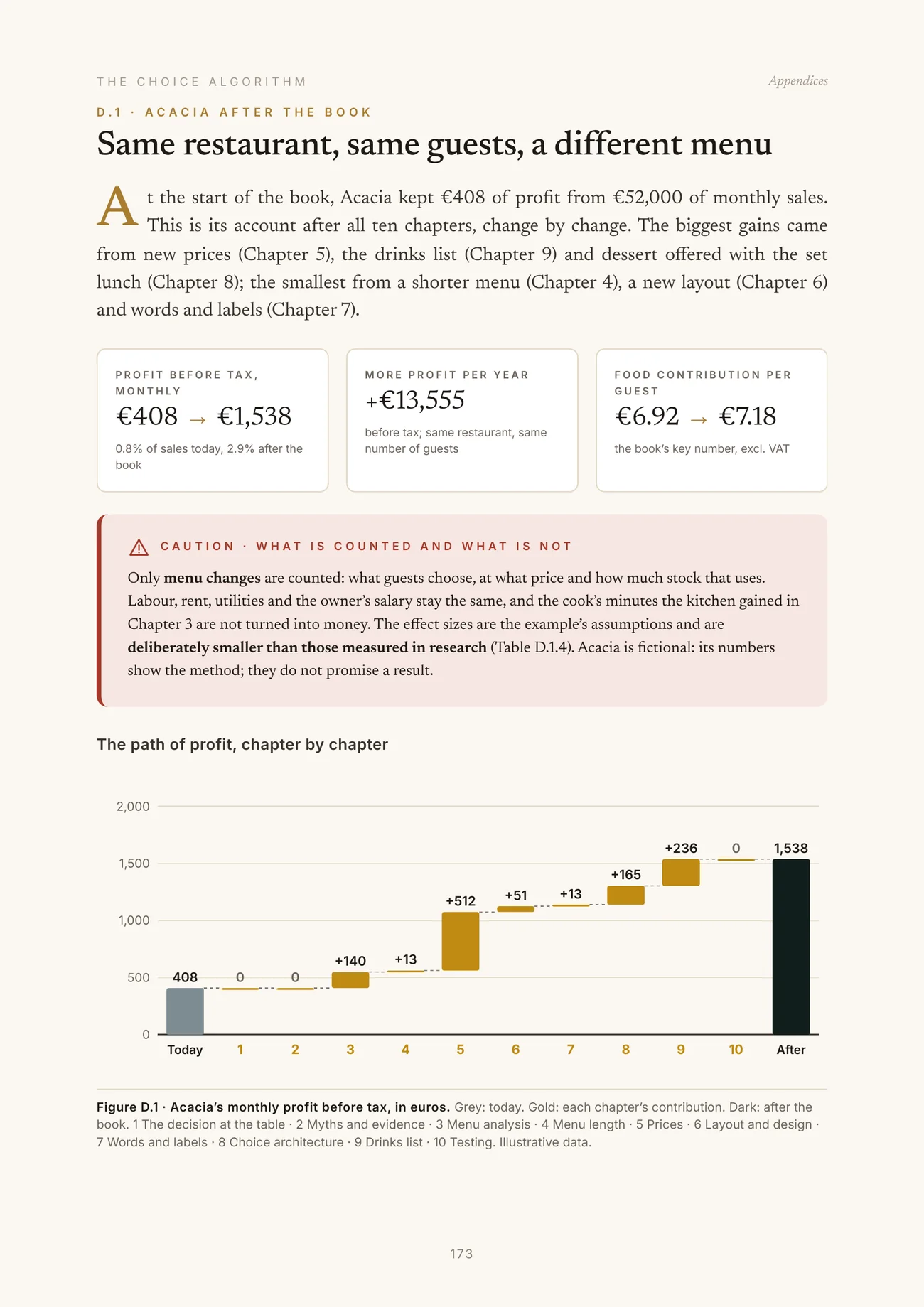
The full menu of Acacia, a fictional restaurant — dishes, prices, costs, sales and labour minutes — runs through the book from the first page to the last. After every chapter the P&L shows what the change brought: from €408 profit before tax a month at the start to €1,538 at the end, from menu changes alone. The assumptions are deliberately more modest than what the research measures.

Page from Appendix D.1: chart of Acacia’s monthly profit after each chapter
Same restaurant, same guests, a different menuAppendix D.1: Acacia’s profit goes from €408 to €1,538 a month, from the menu alone.
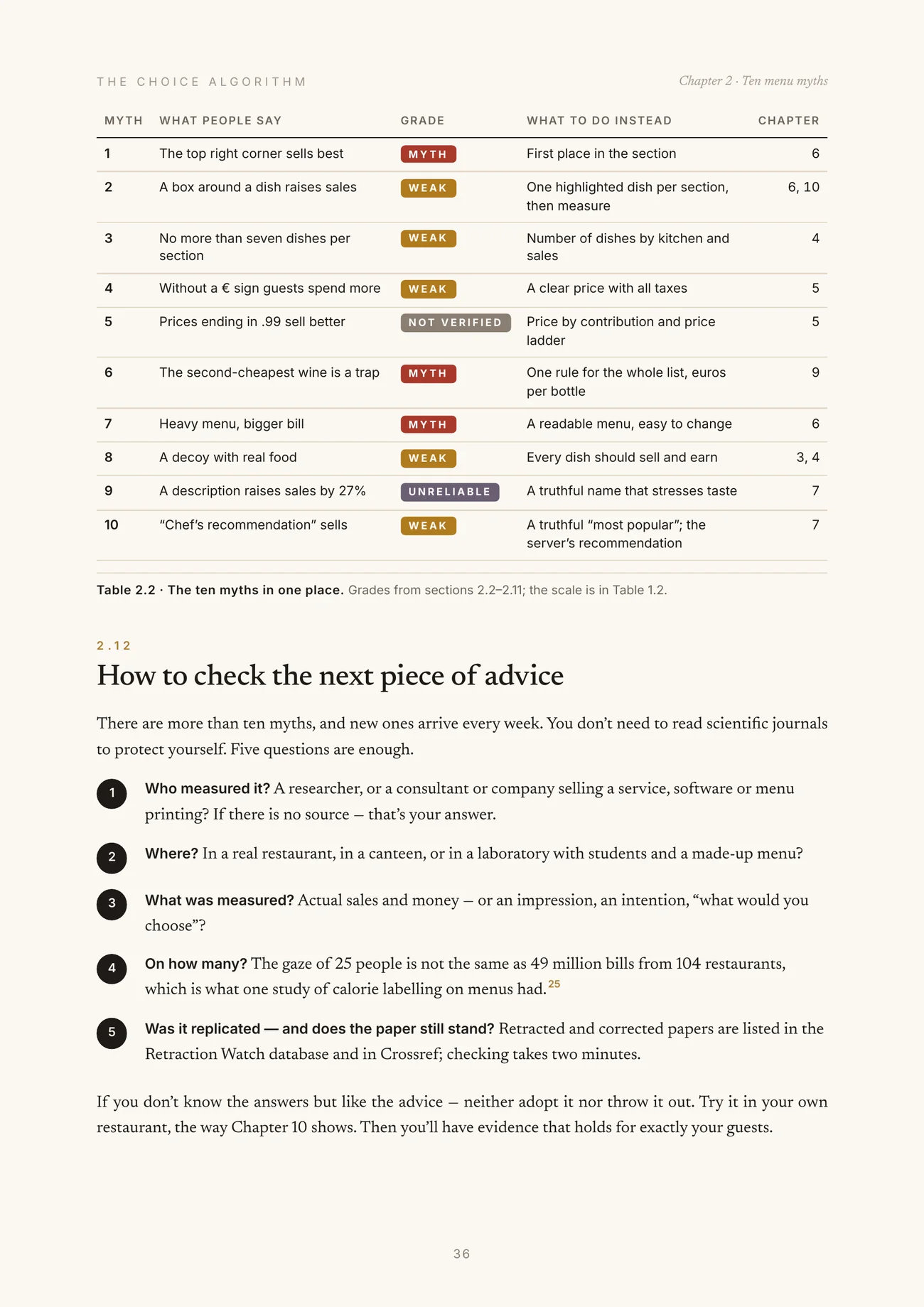
Page from Chapter 2: table of ten menu myths with their evidence grades
Ten myths in one placeWhat people say, what was actually measured and what to do instead.
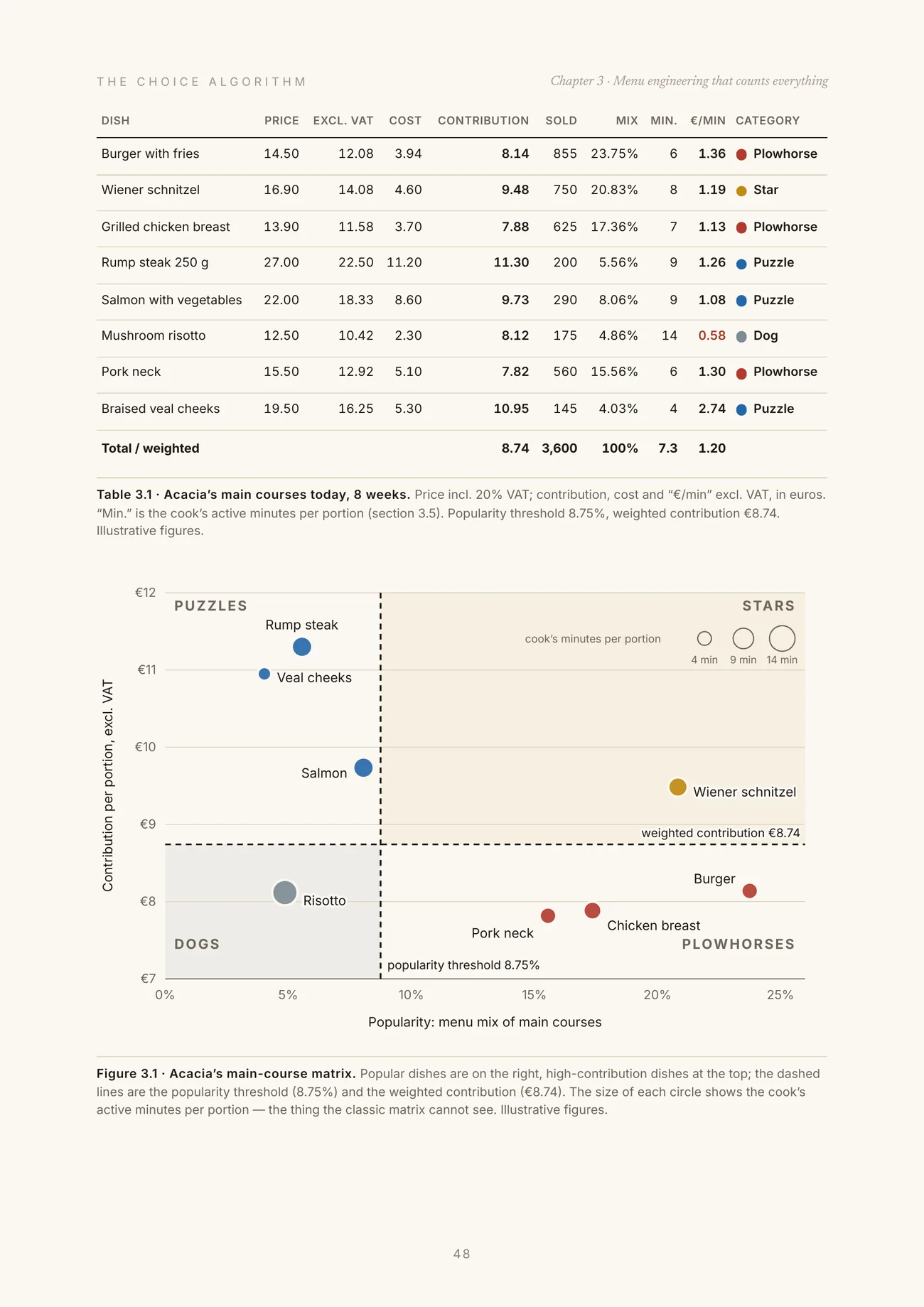
Page from Chapter 3: matrix of Acacia’s main courses, circle size showing labour minutes
A menu matrix that counts labour tooStar, plowhorse, puzzle, dog — and the cook’s minutes per portion.
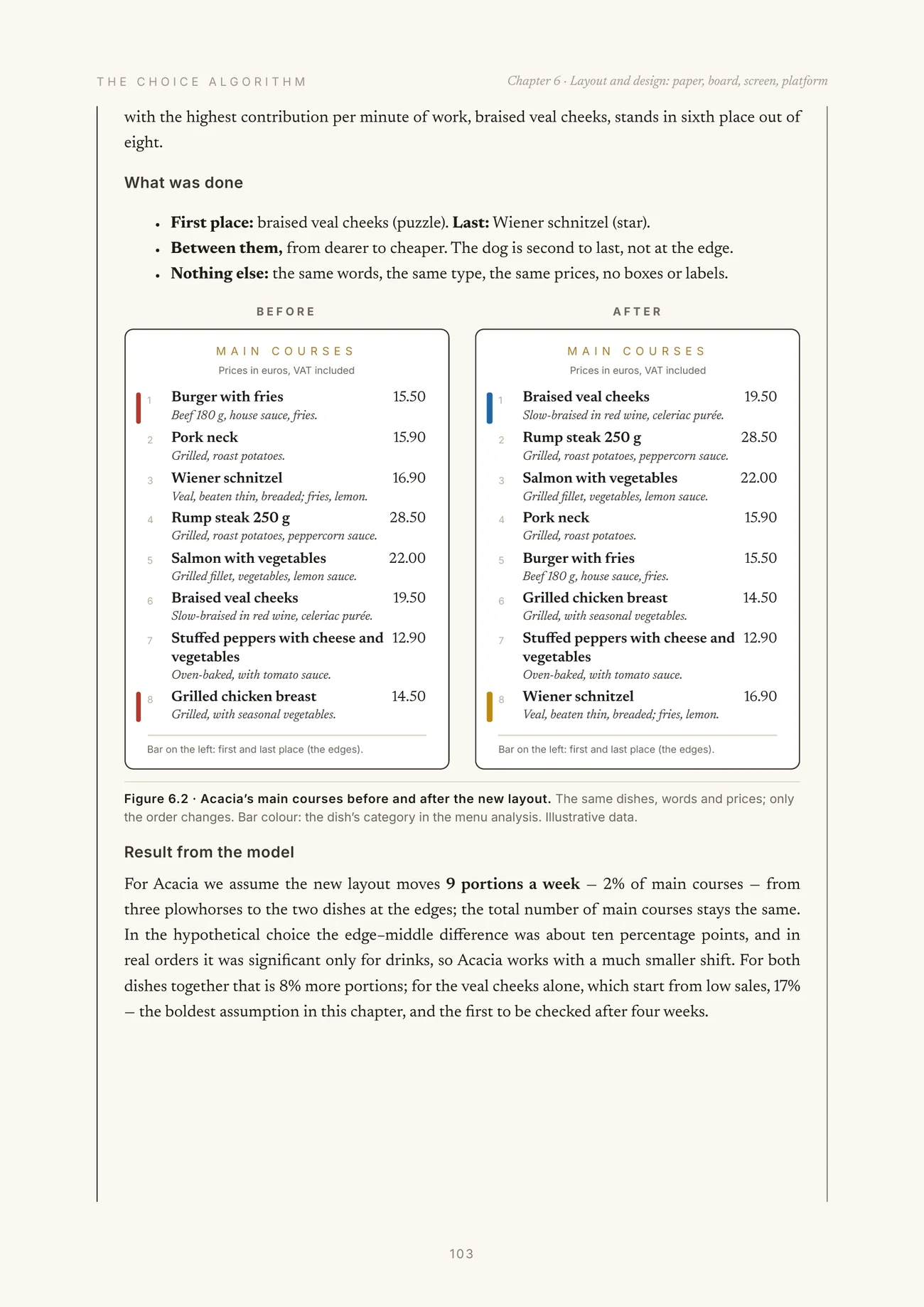
Page from Chapter 6: Acacia’s main courses on the menu before and after the new layout
The menu before and afterSame dishes, a different layout: what moves and why.
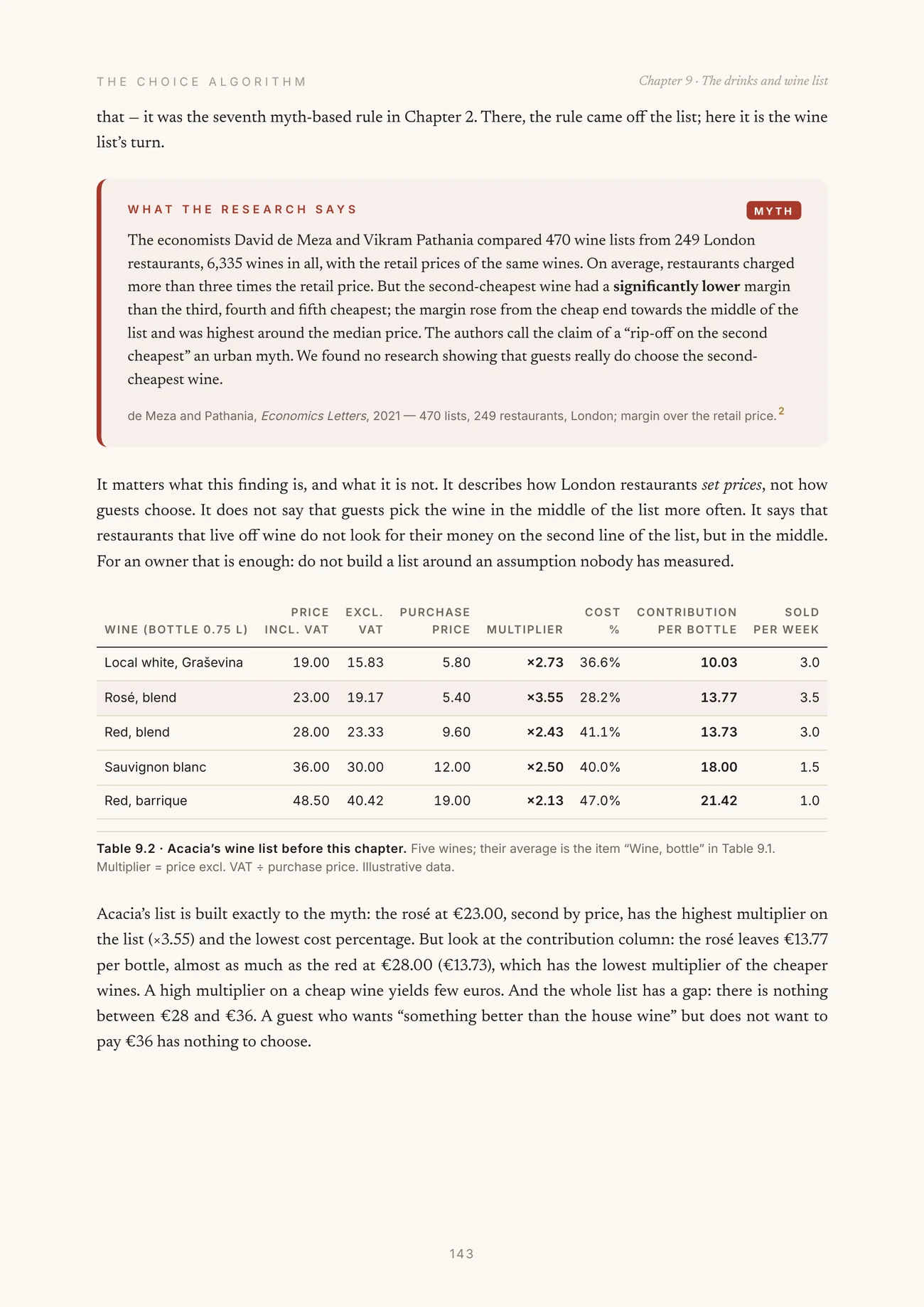
Page from Chapter 9: the box on what research says about the second-cheapest wine, and Acacia’s wine list
A wine list without the mythWhere a restaurant really makes its money on wine.
Page from Chapter 10: the menu dashboard with the book’s ten numbers before and after
The dashboard: ten numbersBefore and after, for every chapter of the book.
Price

One book, one price. Everything included.

Each book in the trilogy is a single product: the book with every form, workbook, template and poster that goes with it. No tiers and nothing extra to pay.

Book 1 · available

The Choice Algorithm

The book and every resource that comes with it, for your restaurant and your team.

€39€27.30−30% for early buyers · one-time payment
Get the book

What you get

  • The Choice Algorithm e-book, 2026 edition, PDF, 191 pages
  • 19 forms for printing on A4
  • The same forms to fill in on screen, in A4 and US Letter
  • Excel: Menu analysis with labour minutes, and the Menu dashboard
  • Excel workbooks for the chapters: Ingredient map, Prices and price ladders with the price change plan, Drinks and wine list, Test check
  • Acacia workbook: the whole menu from the book in one spreadsheet, with formulas and the P&L
  • Word templates: Dish names and descriptions, Multilingual menu, Allergen matrix
  • AI prompts for ChatGPT, Claude and Gemini: dish descriptions, menu translation, menu review
  • Menu audit kit to use with your team: a myth check and a 50-point checklist
  • Wall posters (A3): rules of a good menu, the allergen matrix, rules for testing
  • Video guides for the Excel workbooks
  • The yearly updated edition free of charge, and the owners’ community on WhatsApp and Viber

The workbooks run in Excel, Google Sheets and LibreOffice; the templates in Word, Google Docs and LibreOffice.

The whole trilogy: all three books for €99

Each book costs €39. All three together cost €99 instead of €117 — a saving of €18. All three books are out; if you have already bought one or two, you pay only the difference for the set.

Book 1 · The Choice Algorithm
€39
Available · early buyers −30%: €27.30
Book 2 · The Code Equation
€39
Available · early buyers −30%: €27.30
Book 3 · The AI Ecosystem
€39
Available · early buyers −30%: €27.30

Checkout is through Gumroad. Once you pay, the download link arrives in your inbox right away.

Who the trilogy is for

For people who build menus. Not for people looking for tricks.

This book is for you if

  • you run a restaurant, bistro, tavern, bar or hotel restaurant and decide the menu yourself
  • you are a head chef or manager responsible for prices and sales
  • you are preparing a new menu and want to build it on evidence, not on gut feeling
  • you are a designer or consultant who creates menus for hospitality businesses

This book is not for you if

  • you want tricks that get guests to pay for things they didn’t want
  • you are looking for recipes or cooking techniques
  • you are not prepared to measure a change before calling it a success
Srđan Mihailović in chef’s whites and toque
About the author

Srđan Mihailović

More than thirty years in hospitality: in top hotel kitchens and restaurants and on cruise ships. He has worked and lived on four continents and knows both sides of the business — the one at the stove and the one at the owner’s desk.

He is the founder and owner of Gostíno.ai, an agency that helps hospitality businesses run their work with digital tools.

The same job is bound by the same problems everywhere.

Questions

Before you choose

What format is the book?

A 191-page PDF, 2026 edition. It reads on a phone, tablet or computer. The printable forms are A4; the fill-in forms for the computer come in A4 and US Letter.

What language is it in?

British English. There is also a Serbian edition, Algoritam izbora.

Are Book 2 and Book 3 out?

Yes. Book 2, The Code Equation: menu maths — food cost, standard recipes, pricing and stock. Book 3, The AI Ecosystem: QR menu, allergen matrix, POS and KDS as one system.

How does the trilogy set work?

Each book costs €39; all three together cost €99. All three books are out. If you have already bought one or two, you pay only the difference up to €99.

What comes with the book?

Everything: forms to print and to fill in, the Excel workbooks and the Acacia workbook, Word templates, AI prompts, the menu audit kit, wall posters and video guides. No tiers and nothing extra to pay.

Do I need to read Restaurant Code first?

No. The Choice Algorithm stands on its own. If you have Restaurant Code, you will recognise Acacia: the same restaurant and the same starting point, but this book goes much deeper into the menu.

What does the evidence grade mean?

Every claim says how well it has been measured: strong, moderate, weak, myth, unreliable or not verified. The grade belongs to the claim, not to its author, and it is the same throughout the book; a table of every claim is in the appendix.

Are the examples from a real restaurant?

No. Acacia is a fictional restaurant, the same one from the first page to the last. Its numbers show the method; they don’t promise a result. Every fact from research has a source at the end of its chapter.

How do I get the book after I buy it?

Checkout is through Gumroad. Once you pay, the download link arrives in your inbox right away.

One change to the menu. Four weeks of measuring.

Then a decision based on the numbers, not on gut feeling.