E-book · Vol. I · 2026 edition
Pizza Architecture, Vol. I
The Science of Dough and Fire. 131 pages, PDF.
The Science of Dough and Fire — the dough, the fire, and what holds up when you check.
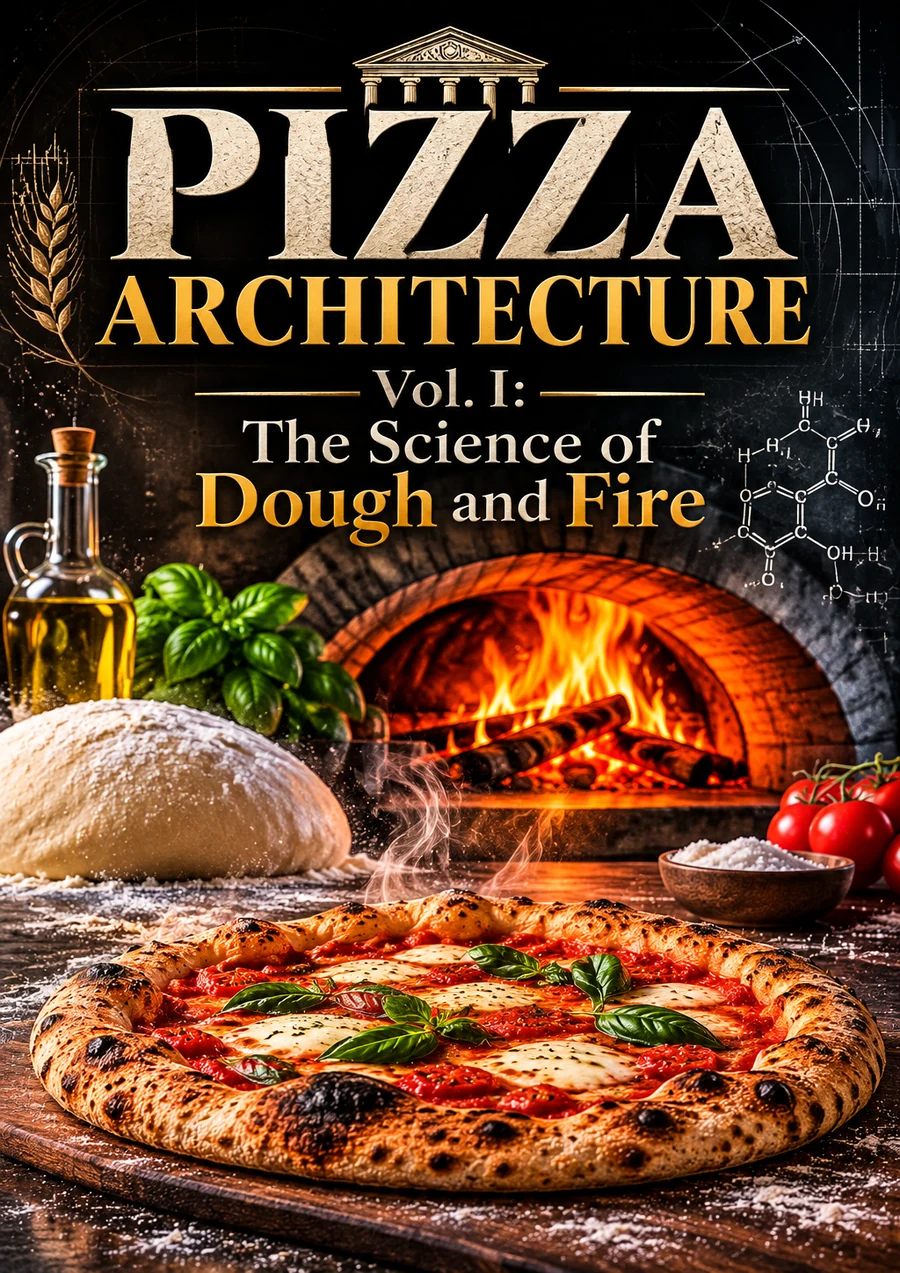
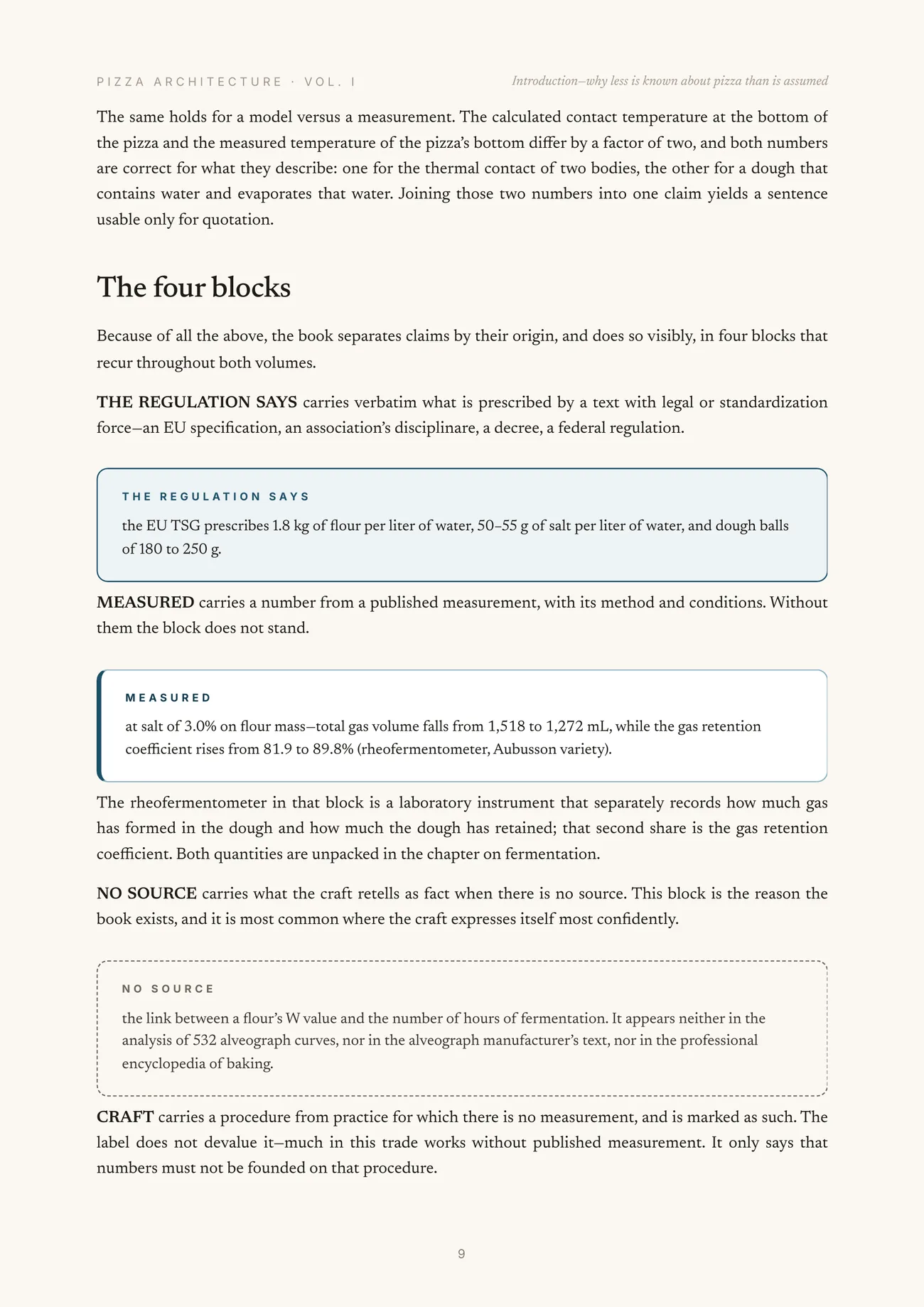
From flour to the baked base: material, time, energy and structure, application. Every claim says where it comes from — a measurement, a regulation, or the craft — and five types of marked block keep them apart: Measured, Regulation says, No source, From the craft and What to measure.
| No. | Chapter | Part | Inside |
|---|---|---|---|
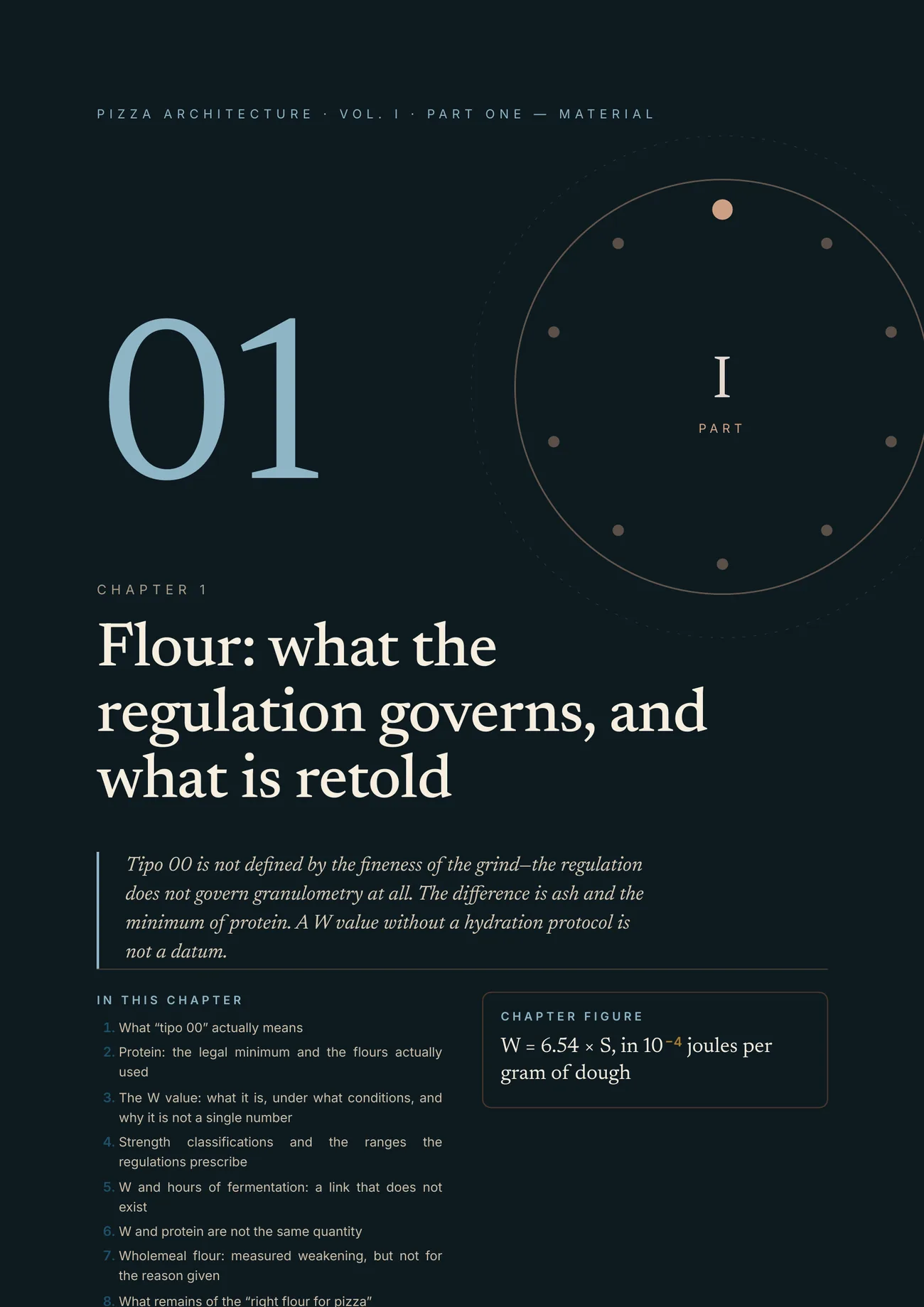
| 01 | Flour: what the regulation governs, and what is retold | I · Material | What “tipo 00” really means · protein and the legal minimum · the W value, and why it is not one number · wholemeal: measured, but misexplained |
| 02 | Water, salt, and fat: three underestimated ingredients | I · Material | Hardness and pH are not the same · water temperature is calculated, not seasonal · salt and gluten · salt and yeast · fat and oil, measured versus merely cited |
| 03 | Hydration: a number without a standard | I · Material | It is all in the denominator · prescribed doses · the 66–70% Neapolitan standard · hydration is not absorption · salt changes the meaning of the number |
| 04 | Yeast: biology and dose | II · Time | S. cerevisiae · three products, not one ingredient · the foam test · why no dose table is internally consistent · a working dose table |
| 05 | Fermentation: temperature, time, and what is actually measured | II · Time | What the rheofermentometer measures · temperature: direction known, coefficient not · the target dough temperature · autolyse · time, on the wrong scale |
| 06 | Cold dough: what is gained and what is lost | II · Time | What “cold” is · aroma gained, gluten lost · the fridge produces acidity · the 72-hour limit · safety: two regulations |
| 07 | Rheology: gluten from powder to network | III · Energy & structure | Two ingredients of one glue · the stages of kneading · over-kneading · windowpane, with its qualification · shaping, without measurement |
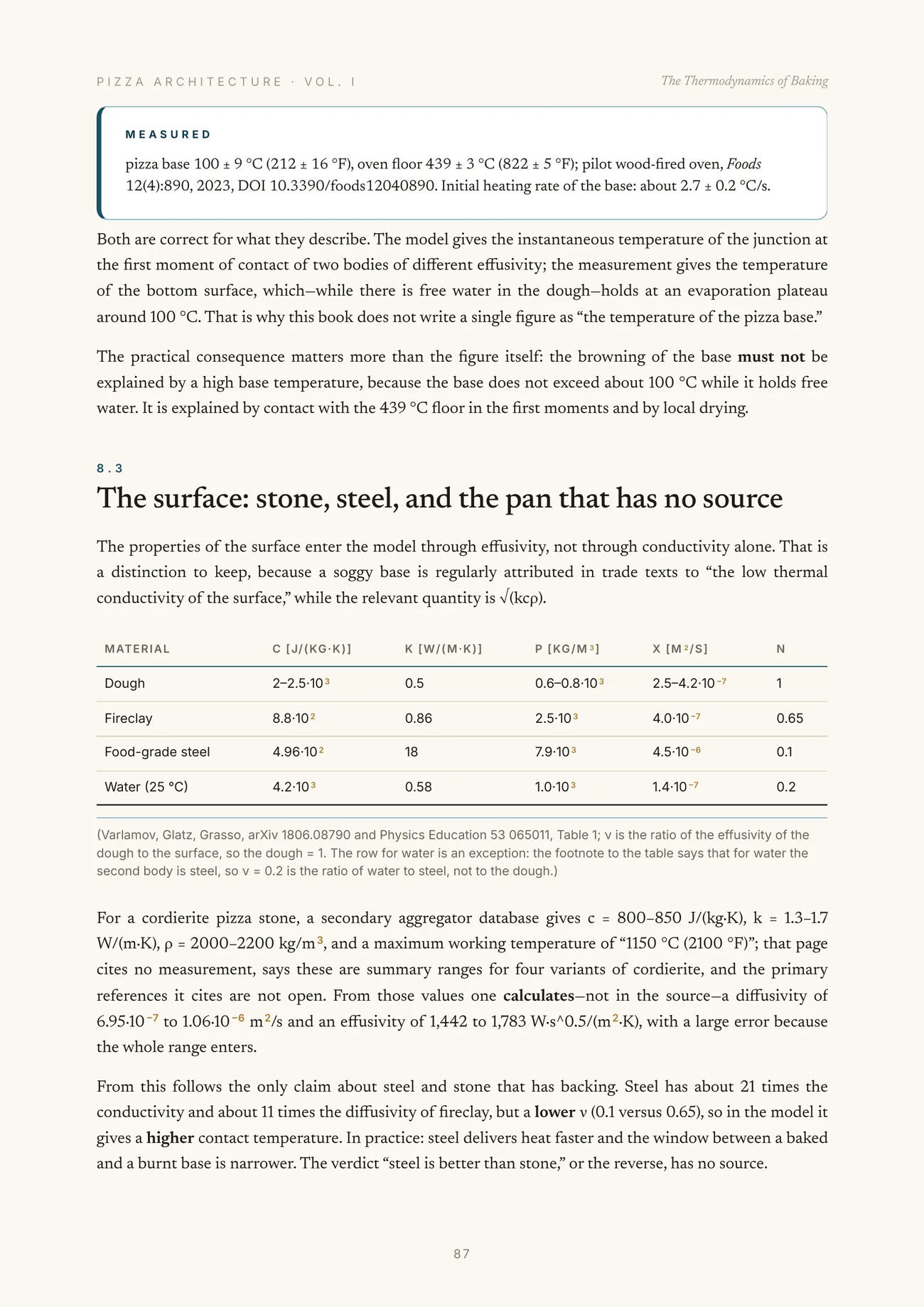
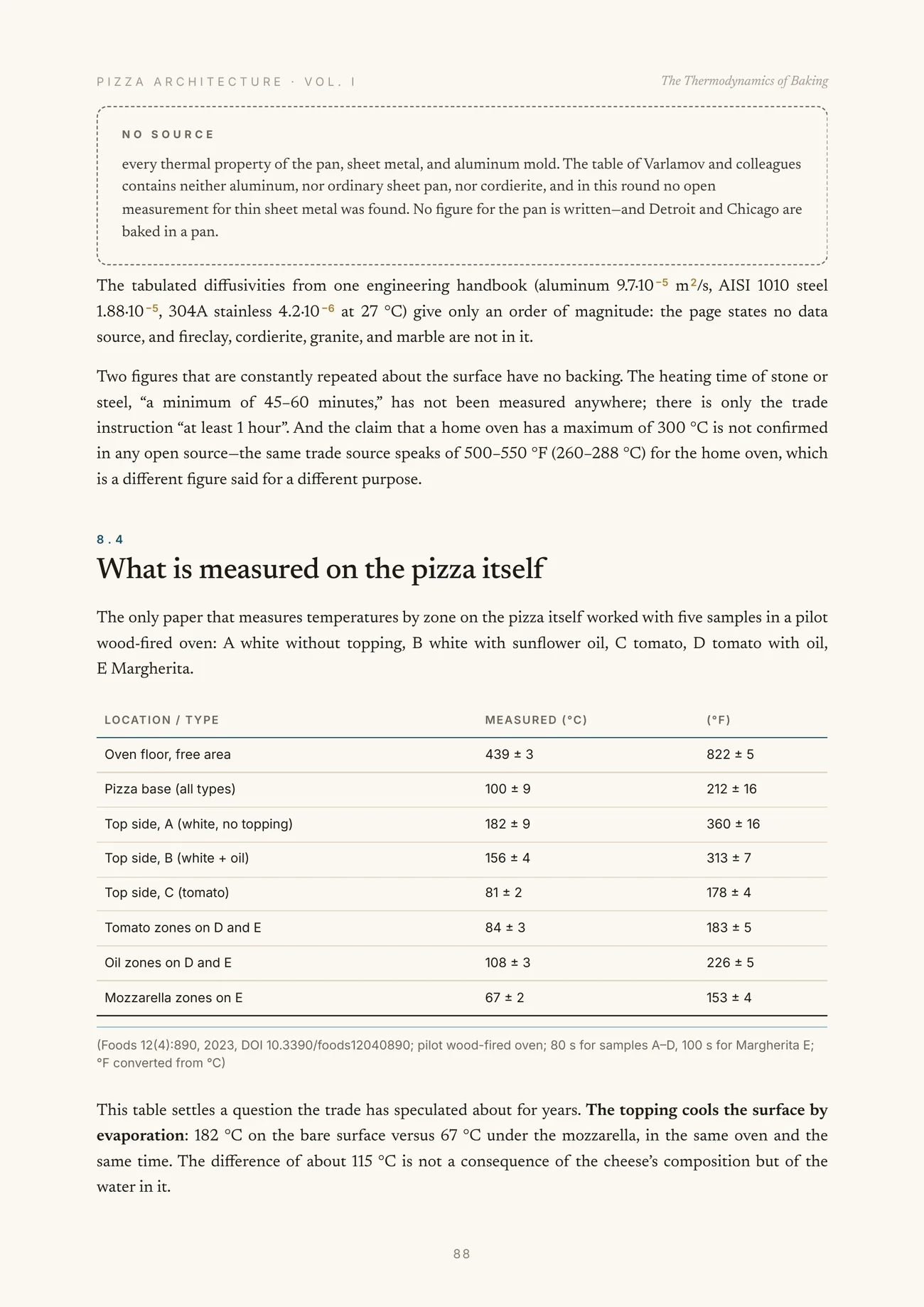
| 08 | The thermodynamics of baking | III · Energy & structure | Three mechanisms and one geometry · two base temperatures · stone, steel and the pan · what is measured on the pizza · Maillard without a temperature threshold |
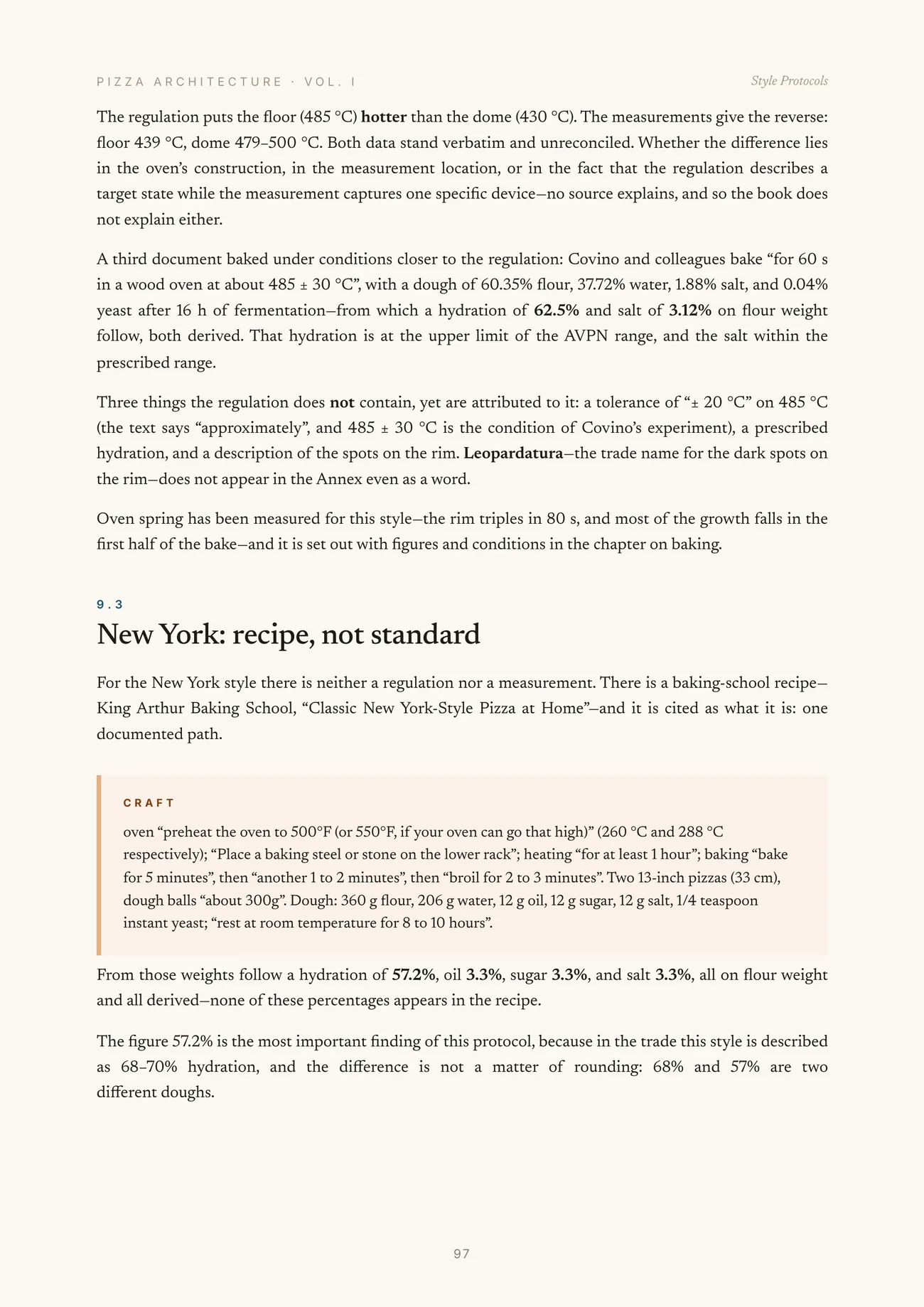
| 09 | Style protocols | IV · Application | Neapolitan (AVPN), New York, Detroit, Roman and Chicago — each read as regulation, recipe or craft, every figure with its source |
| 10 | Diagnostics: from symptom to cause | IV · Application | A fault tree that runs from the baked result back to the decision that caused it |
Every claim carries its origin — measured, prescribed, or craft — and every temperature is given in °C and °F. Click a page to see it larger.
The whole of Volume I and both Excel tools, bought once — yours to keep.
The Science of Dough and Fire. 131 pages, PDF.
Checkout runs through Gumroad. After payment the download link arrives straight away by e-mail.

More than thirty years in hospitality: in hotels, restaurants, resorts and catering across Europe, Scandinavia, the Mediterranean, the Middle East and the Caribbean.
He is the founder of Gostíno.ai and the builder of the gostino.app website, where the hospitality trade meets modern digital tools.
A pizza is not a recipe. It is a measurement with a tolerance.
A 131-page PDF, 2026 edition. It reads on phone, tablet and computer; the contents links straight to every chapter. The two Excel tools arrive alongside it as separate files.
English, with every temperature in both °C and °F. There is also a Serbian edition, Pizza Architecture, Tom I — Nauka o testu i vatri, the same volume.
No — each stands on its own. Volume I is the dough and the fire: flour, hydration, fermentation, rheology and the thermodynamics of baking. Volume II is the topping, read as chemistry. Together they make the complete monograph.
Five types — Measured, Regulation says, No source, From the craft and What to measure — so you always know whether a claim comes from a measurement, from a regulation, or from the craft, and which ones you may change.
The dough calculator, which builds a recipe at any flour mass by baker’s percentage with a hydration check, and the fermentation log for temperature, time, observations and outcome. Both come with the book as plain Excel files.
Checkout runs through Gumroad. After payment the download link arrives straight away by e-mail.
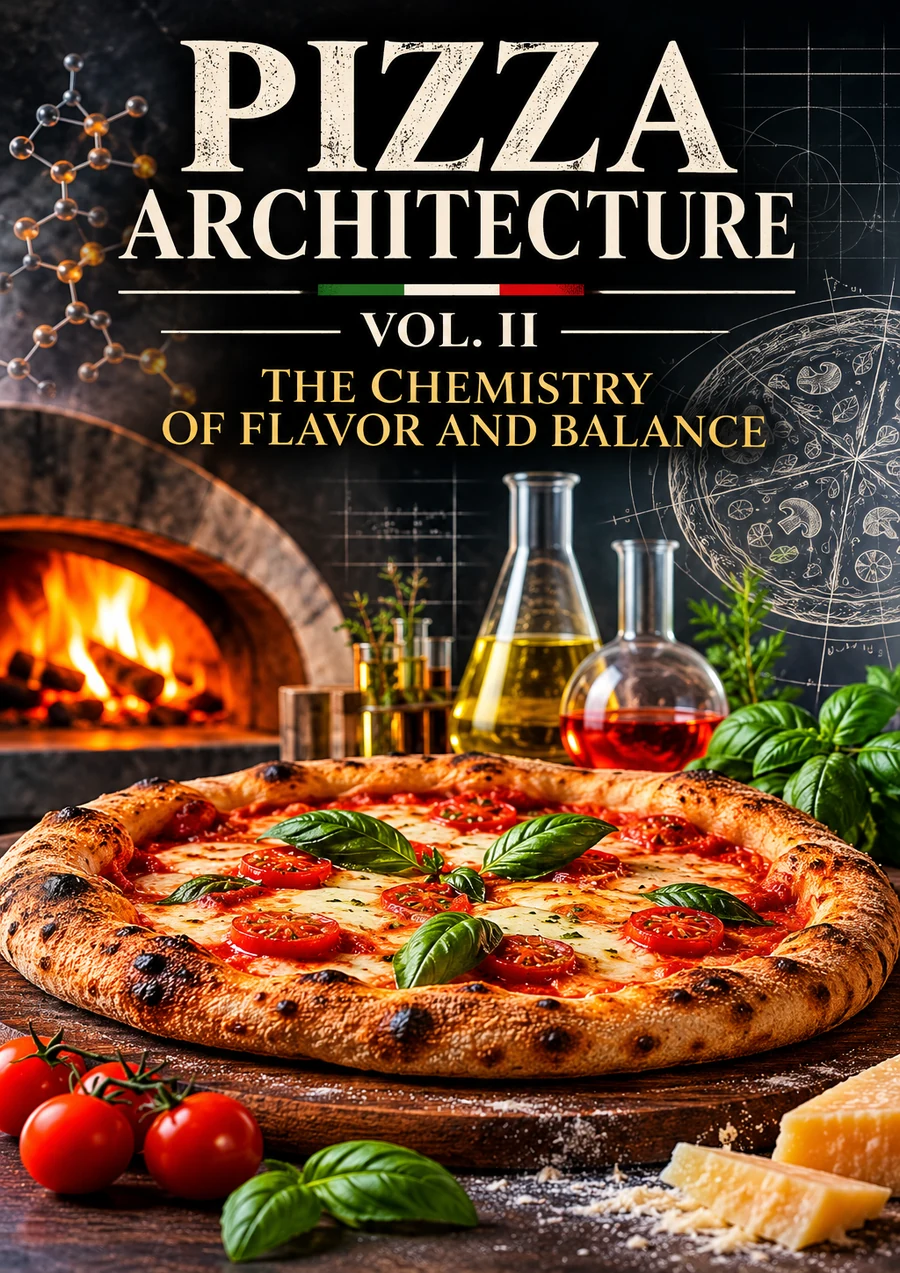
Both volumes together make the complete monograph — Volume I the dough and the fire, Volume II the topping.

What is measured, what is prescribed, and what is craft — kept apart.